

Switching your broadband provider might sound like a hassle, but thanks to the UK's One Touch Switching process it has never been simpler or faster. Whether you want a cheaper monthly bill, a faster connection, or a provider with better customer service, this guide explains everything you need to know, from checking your postcode to picking up your new router and staying online without interruption.
Switch provider in three easy steps
Check your postcode
Enter your postcode into our broadband comparison tool to instantly see every deal available at your address. The results show the technology type (ADSL, FTTC, FTTP, or cable) as well as the estimated download speed so you can make a fair comparison.
Compare broadband packages
Sort by monthly price, download speed, or total contract cost. Filter by contract length, provider, or speed tier to narrow down the options. Our comparison table shows the full monthly cost including any line rental so there are no surprises on your first bill.
Select the right deal for you
Once you have chosen your new package, click through to the provider's checkout. Your new provider handles the switching process end-to-end using One Touch Switching. You do not need to contact your old provider, they will be notified automatically and your service will transfer on the agreed date.
Is it easy to switch broadband provider?
Yes, switching broadband is much simpler than most people expect. Since September 2023, the industry-wide One Touch Switching (OTS) system has been in operation, which means you only need to sign up with your new provider. Your new provider contacts your old one on your behalf, co-ordinates the transfer date, and migrates your service with no gap in connectivity in most cases. The entire process typically takes between five and fifteen working days from sign-up to go-live.
The only exception is if you are moving from a cable provider (such as Virgin Media) to a phone-line-based provider, or vice versa. In those cases a small broadband-free window is possible because different physical infrastructure is involved. Your new provider will advise you of the exact switch date and what to expect during the transition.
Do I need to cancel my current broadband contract when I switch providers?
No, under the One Touch Switching framework introduced by Ofcom, your new provider manages the entire switching process for you. When you place an order with a new broadband supplier, they send a switch notification to your current provider automatically. Your current provider is then required by regulation to acknowledge the switch and release you on the agreed date without charging a cancellation admin fee.
However, if you are still inside your minimum contract term, an early termination charge (ETC) may apply. Your current provider must tell you the exact amount of any ETC before the switch completes, so you can make an informed decision. If you are out of contract — or moving to a new address where your current provider does not offer service, you should not face any exit penalty. Always check your contract documents or use your provider's online account portal to confirm your contract end date before you start comparing deals.
One important note: you will need to return any router or equipment provided by your old supplier within the timeframe stated in your contract — usually 30 days — to avoid being charged. Your new router from the incoming provider will arrive before or on the day of your switch date so you are never left without a way to connect.
When can I switch broadband without penalty?
You can switch without paying an early termination charge in the following circumstances:
Your minimum contract term has ended and you are rolling month-to-month. Once your initial contract period expires you are free to leave at any time without an exit fee.
Your provider has raised your monthly price mid-contract without adequate notice. Under Ofcom rules, a mid-contract price rise that is above the rate agreed at sign-up gives you the right to exit penalty-free within 30 days of being notified.
Your provider has failed to deliver the minimum guaranteed speed stated in your contract after repeated reported faults. Ofcom's Automatic Compensation scheme entitles you to compensation and, in severe cases, the right to exit without penalty.
You are within the 14-day cooling-off period after signing a new contract. The Consumer Contracts Regulations 2013 give you 14 days from the date your service starts (or the date your contract is signed if service has not started) to cancel without any exit charge.
If none of the above apply and you are still inside your contract, it is worth calculating whether the savings on your new deal outweigh the ETC. In many cases, particularly if you have only a few months remaining, it can still be worth paying the charge to lock in a better long-term rate.
How long does it take to change providers?
In most cases the switch happens within five to fifteen working days of placing your order with the new provider. The exact timescale depends on the type of technology at your address and whether an engineer visit is required.
For like-for-like FTTC fibre (where both old and new providers use the same Openreach infrastructure), the switch is almost always seamless with no gap in service. Your new router is provisioned remotely on the agreed date and you simply plug in the new equipment. For full-fibre FTTP connections where new physical infrastructure needs to be installed, an engineer appointment may be required, which can extend the lead time to three to four weeks. Your new provider will confirm the exact date at the time of ordering and send you reminders in advance.
If you are switching from a cable provider (Virgin Media) to an Openreach-based provider, or vice versa, there may be a short period — typically 24 to 48 hours — where you are without broadband while the old service is deactivated and the new one activated. Your new provider will advise you on this and suggest ways to stay connected during the gap, such as using mobile data.
Reasons to switch to a new broadband deal
There are many valid reasons to start comparing broadband deals, from saving money to improving your connection speed. Here are the most common reasons UK households decide to switch:
I want cheaper broadband
Loyalty rarely pays with broadband. Providers frequently offer their best prices to new customers, meaning long-standing customers on rolling contracts often pay significantly more than switchers. If your contract has ended, you could save £10–£30 per month simply by moving to a current deal, with the same or better speeds.
I want faster broadband
Full-fibre broadband (FTTP) is now available to over 60% of UK premises and delivers speeds of 100Mbps, 500Mbps, or even 1Gbps. If you are still on an older ADSL or FTTC connection and struggling with buffering, video call lag, or slow uploads, switching to a full-fibre provider could transform your home connectivity.
I'm out of contract
When your minimum contract term ends, you move onto a rolling monthly tariff that is often significantly more expensive. This is the ideal time to compare deals, you have maximum flexibility, no ETC to worry about, and the full range of introductory offers available to new customers.
I'm moving home
Moving house is one of the most common triggers for switching broadband. Your current provider may not serve your new address, or a different provider may offer a significantly better deal there. Always check availability at your new postcode before assuming your existing supplier can follow you, and use the move as an opportunity to shop around.
I'm paying for services I don't need
Many broadband bundles include TV packages, landline call plans, or add-on services that you might never use. If your needs have changed — for example, you have cancelled your TV subscription or stopped making landline calls — switching to a broadband-only or SIM-included package could reduce your monthly outgoings considerably.
Broadband switching statistics
According to Ofcom's Connected Nations and market data reports, over 3.5 million UK households switch their broadband provider each year. Despite this, research consistently shows that many consumers who are out of contract remain on expensive rolling tariffs for 12 months or more, paying an average of £113 more per year than they need to. The chart below illustrates how broadband switching rates vary by region across the UK, with London and the South East leading in switching activity and rural areas showing lower rates, partly due to fewer available providers at those postcodes.
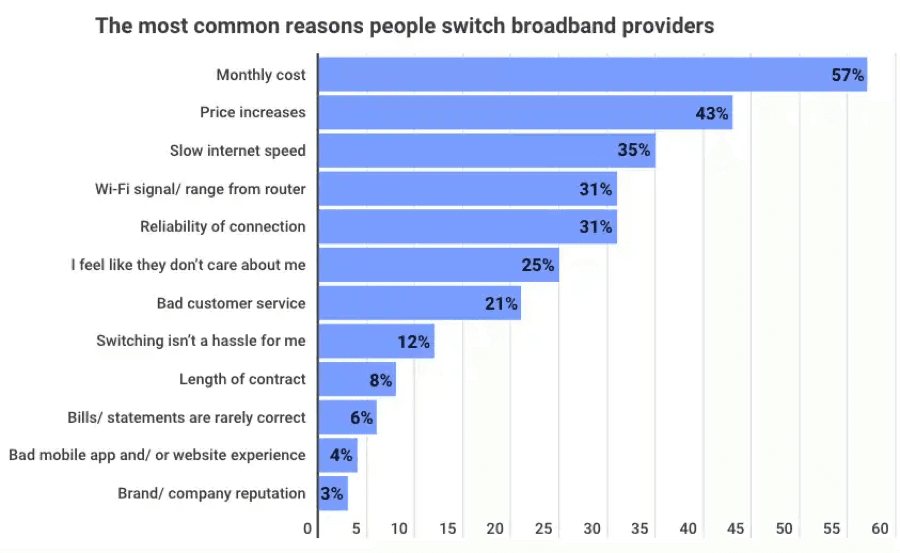
Source: Ofcom Connected Nations report. Figures represent annual switching volumes by region across residential broadband customers.
Does switching providers cost money?
Switching broadband is free in most cases, provided you are out of contract or are switching under a circumstance that allows penalty-free exit. There are no admin or transfer fees charged by either your old or new provider under the One Touch Switching framework, Ofcom prohibits providers from levying switching charges on customers who are entitled to leave.
The main potential cost to be aware of is the early termination charge if you are still inside your minimum contract term. This charge is calculated based on your remaining monthly payments and must be disclosed to you upfront by your current provider before the switch is completed. Some new providers offer a bill credit or switching incentive that partially or fully covers an early termination charge, it is always worth asking.
In rare cases where a new physical line needs to be installed, for example, if you are upgrading to full-fibre on infrastructure that has not been previously installed at your property, there may be a one-off installation charge. However, many providers waive this during promotional periods. Always read the order summary carefully before confirming your new deal.
Our expert says
“The best time to switch broadband is the moment your contract ends — not six months later when you finally notice your bill has crept up. Set a reminder a month before your contract expires and use that window to compare.”
“Don't assume your current provider will match a competitor's price without you asking. Call the retentions team and quote the deal you have found, in many cases they will offer you a discounted renewal to keep your business.”
“Full-fibre is worth upgrading to even if your current speeds feel adequate. Symmetric upload speeds make a real difference for home working, video calls, and smart home devices, and the price difference from FTTC is often smaller than people expect.”
SwitchSquid Editorial Team
Changing broadband providers FAQs
Can I switch broadband deal mid-contract?
Yes, but you may face an early termination charge (ETC). Your provider must tell you the exact ETC amount before you commit to switching. The ETC is usually calculated as the remaining monthly payments left on your contract, minus any savings the provider makes by releasing you early. If you are within the first 14 days of a new contract you can cancel without penalty under the Consumer Contracts Regulations 2013. Always check your contract terms or call your provider to get the exact figure before making a decision.