Last updated: Monday 12 October 2026.
If you recharge HMO tenants for gas or electricity, Ofgem's maximum resale price rule says you can't charge more than you paid your supplier, including a fair share of the standing charge. Sub-meters in each room make that fair and easy to prove. Without them, you must estimate fairly and be able to explain your method if a tenant asks (Ofgem).
This SwitchSquid guide is for landlords and letting agents who hold the energy supply for a shared house and want to recharge it fairly. For the bigger questions of whether your HMO should be on a business or household contract, and which VAT rate applies, see our main energy for HMO landlords page.
We may be paid if you use our business energy form.
Get an HMO energy quote
- Our own business energy form, free with no obligation
- One house or a whole portfolio
- Have your bills and meter numbers ready
Key facts (checked 12 October 2026)
- A maximum resale price applies when energy from a licensed supplier is resold for domestic use, including by landlords to tenants (Ofgem MRP direction).
- Each unit can be resold for no more than the reseller paid for it, and standing charges must be shared fairly (Ofgem guidance).
- Where there's no meter, the price must be estimated so that, over a period of no more than a year, the reseller recovers no more than its cost (Ofgem MRP direction).
- You don't need a licence to resell energy on the same premises, but you must follow the maximum resale price (Ofgem call for input, October 2025).
- In England, a large HMO with 5 or more tenants from more than one household needs a licence from the council (GOV.UK).
Is sub-metering right for your HMO?
Good for: landlords who recharge tenants on usage, HMOs with electric heating in rooms, and houses where usage varies a lot between tenants.
Consider alternatives if: you offer a simple bills-included rent with a fair-use policy, or each tenant already has their own supply and account.
Three ways to charge HMO tenants for energy
How you set up charging decides which rules apply and how much admin you take on. Most HMO landlords use one of three models.
Model | How it works | Resale price rule | What to keep |
|---|---|---|---|
Sub-metered recharge | The landlord holds the main supply, and each room has a sub-meter that's read to split the bill | Applies. No profit on units, and a fair share of the standing charge | Supplier bills, dated sub-meter readings, your calculation |
Estimated recharge | The landlord holds the supply and splits the bill by a fair formula (rooms, occupants) | Applies. Over a year, you can't recover more than you paid | Bills, your written method, a yearly reconciliation |
Bills-included rent | A fixed rent covers energy, with a fair-use policy | Ofgem's guidance treats this differently, so check the current position | A clear tenancy clause and your fair-use terms |
Tenants' own supply | Each unit has its own meter and supplier account | Doesn't apply, because you aren't reselling | Meter readings at move-in and move-out |
Ofgem opened a review of the resale rules in October 2025, asking for views from landlords and property managers among others (Ofgem). Check for any updates before you change how you charge.
How the maximum resale price works in practice
Ofgem's rule is simple to state: you can charge tenants what you paid the supplier per unit, plus a fair share of the standing charge, and no more. Ofgem's guidance asks resellers to recover no more than they paid and to use a logical method they can explain to tenants on request (Ofgem guidance). Energy used in common parts, such as hallway lights, isn't part of the tenants' metered share under the estimation rule. Treat it as a landlord cost or cover it transparently in the rent. Anyone who charges more than the maximum resale price can face civil proceedings to recover the overcharge, plus interest.
A worked example
Say your supplier charges 25p per kWh and a standing charge of 60p a day, and a 5-room HMO uses 3,000 kWh in a quarter of 91 days. The bill is £750 for units plus £54.60 standing charge, so £804.60 before VAT. If Room 1's sub-meter shows 700 kWh, the most you can charge for its units is £175. Its fair share of the standing charge, split equally across 5 rooms, is £10.92. Add the matching share of the VAT you were charged. These numbers are only an example. Use the rates on your own bill.
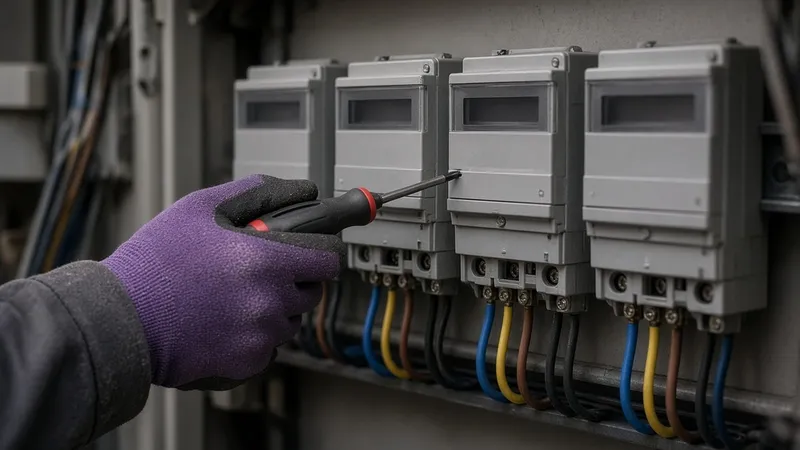
Room sub-meters make recharging simple to explain, because each tenant pays for the units their room uses.
Setting up sub-meters
A sub-meter sits after the main meter and measures one room or flat. It doesn't change your contract with the supplier. You still hold one supply and pay one bill, and the sub-meters tell you how to split it.
Use a qualified electrician. Sub-meter installation is electrical work, and it should be done and certified by someone competent.
Choose meters you can read reliably. Some landlords use smart or remote-read sub-meters so they don't need to enter rooms. Tell tenants how and when readings are taken.
Record readings at every change. Take dated readings, ideally with photographs, at move-in, move-out and each billing date.
Put it in the tenancy. Explain how energy is charged, how the standing charge is shared and that tenants can see the supplier bills.
Gas is harder to sub-meter in a typical HMO, because heating and hot water often come from one boiler. Most landlords split gas by a fair formula and reconcile it once a year against the actual bills.
Squid AI tip: open Ask Squid AI (the purple chat bubble in the bottom corner of the page) and ask "How does the maximum resale price work for an HMO landlord?". It explains the terms in plain English. It won't give you a price, because business prices depend on your meters and dates.
Your supply contract still matters most
Whatever you recharge, your tenants' costs start with the rate on your own supply contract. A high unit rate or an out-of-contract tariff feeds straight into every room's share. Check your end date, compare quotes before it arrives and make sure your supplier has a VAT declaration if the supply is used for qualifying residential purposes (HMRC VAT Notice 701/19). Our HMO landlords page explains when a business or household contract makes more sense.
Compare supply contracts for your HMO
- Unit rate, standing charge and total yearly cost on every quote
- A fixed price makes recharging easier to plan
- Free, with no obligation
Licensing and your energy set-up
In England, a large HMO, meaning one rented to 5 or more people from more than one household who share facilities, must be licensed by the council, and councils can license smaller HMOs too (GOV.UK). Licence conditions focus on safety and management rather than energy prices, but you'll need gas safety and electrical safety records in order. Rules differ in Wales and Scotland, so check with your local council.
Important conditions
Before you change how you charge
- The maximum resale price applies to energy resold for domestic use. Charge no more than you paid.
- Keep your bills and readings, because tenants can ask how you worked out their charge.
- Ofgem has been reviewing the resale rules since October 2025, so check for updates.
- This guide is general information, not legal advice. Check tenancy wording with a qualified adviser.
Frequently asked questions
Can an HMO landlord make a profit on energy?
No, not when you recharge tenants for energy they use in their homes. Ofgem's maximum resale price means each unit can be resold for no more than you paid your supplier, and standing charges must be shared fairly. Over a year, you shouldn't recover more than your total cost.
Do I need a licence to resell energy to my tenants?
Usually not. Ofgem says you don't need a licence to resell energy on the same premises, such as a landlord reselling to tenants in a shared house. You must still follow the maximum resale price.
How should I split the standing charge between tenants?
Share it fairly and proportionately, for example equally per room or in line with the period each tenant lived there. Write your method down and use it consistently. Tenants can ask you to explain it.
Do I need sub-meters to recharge energy?
No, but they make it easier. Without them, you must estimate each tenant's share fairly and make sure that, over a period of no more than a year, you don't recover more than you paid. Sub-meters replace estimates with real readings.
What about energy used in hallways and shared areas?
Energy used in common parts shouldn't be loaded onto tenants' metered charges. Most landlords treat it as a landlord cost or cover it openly in the rent. Make sure your tenancy explains how it's handled.
Does the resale price rule apply to bills-included rent?
Ofgem's guidance treats a fixed bills-included rent differently from a metered or estimated recharge. Even so, set out clearly in the tenancy what's included and how any fair-use limit works. Check Ofgem for updates, because the rules are under review.
Does my HMO need a licence from the council?
In England, an HMO rented to 5 or more people from more than one household needs a licence, and some councils license smaller HMOs too. Check with your local council, because rules vary by area and in Wales and Scotland.
Your decision
Getting HMO energy right
- Recharge on usage? Fit sub-meters and keep dated readings.
- Charge no more than you pay, and share the standing charge fairly.
- Get a good supply contract first, because it sets every tenant's cost.
For contract type, VAT and void periods, read energy for HMO landlords.
Check what your HMO could pay
- Quotes for one house or a portfolio
- Free, with no obligation to switch
Sources
Questions about business energy? Ask Squid AI
Squid AI explains business energy contracts, renewal dates and switching in plain English, then points you to our business energy quote form.
- Save energy and moneyLearn when a longer fixed business contract makes sense.
- Save timeAnswers in seconds, no forms or sign-up.
- Plain answersNo jargon, no pressure, free to use.