A prepayment meter is a gas or electricity meter that you top up with credit before you use any energy, rather than paying a bill after the fact. Around 4 million UK households use one, and the meter cuts off supply once your credit runs out unless you have emergency credit available. Suppliers fit prepayment meters as standard in some rental properties, after a debt issue, or simply because the previous occupier had one installed. This guide covers how a prepayment meter works for gas and electric, what it costs under the current price cap, and how to switch to a cheaper plan or a standard credit meter.
How Does a Prepayment Meter Work?
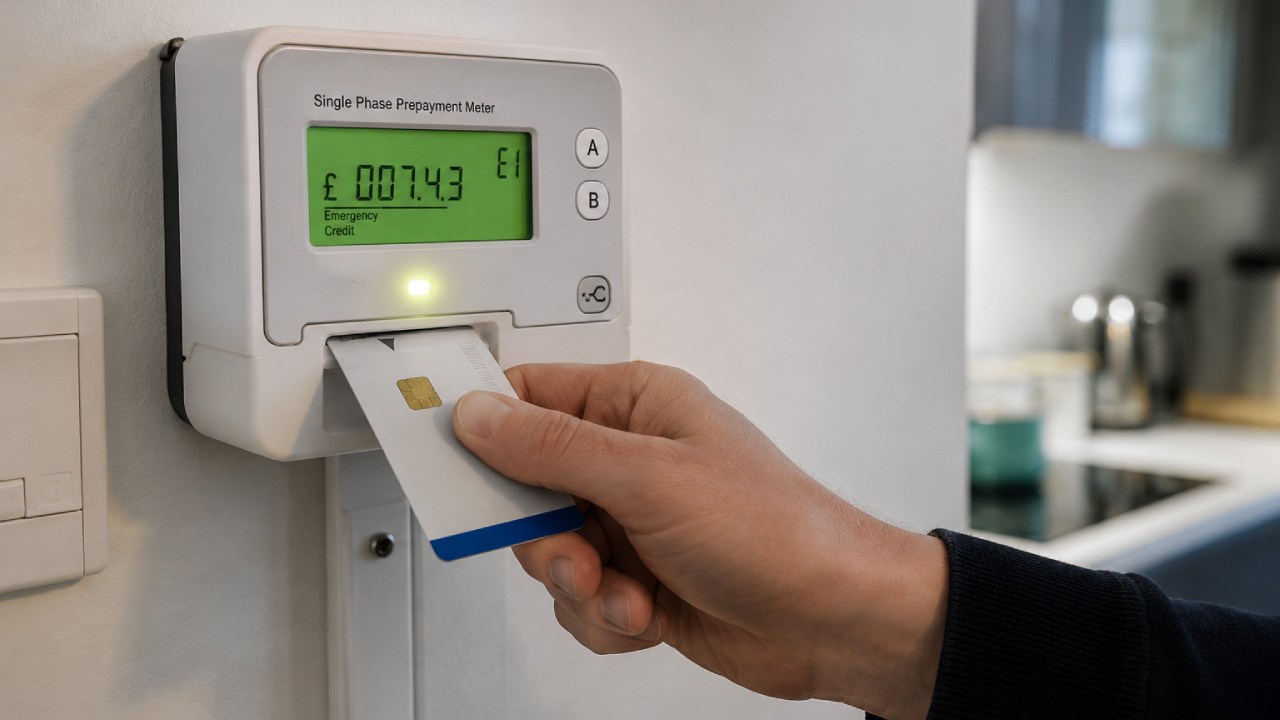
A prepayment meter works by deducting credit as you use gas or electricity, much like topping up a pay as you go phone. You buy credit using a key, smart card, token or supplier app, then load it onto the meter. The meter tracks your balance in real time and displays it on a small screen. Once the balance hits zero, supply stops unless you have emergency credit left.
Every prepayment meter also charges a standing charge, a fixed daily fee that covers the cost of keeping you connected to the network. The standing charge is taken from your credit even on days you use no energy at all, so a meter with no top-ups still racks up debt.
There are 3 main types of prepayment meter: key meters, smart card meters, and smart prepayment meters. The table below breaks down how each one works.
Meter Type | How You Top Up | Best For |
Key meter (electric key) | Electric key or gas key meter token, loaded at a PayPoint or Post Office | Older properties without app or online top-up support |
Smart card meter | Electricity prepayment card or smartcard, topped up in shops | Households near a PayPoint or Payzone outlet |
Smart prepayment meter | App, text, phone or online top-up; credit applies remotely | Anyone who wants pay as you go electricity without a shop trip |
A gas key meter uses a physical key with your tariff data stored on it, while an electric key meter or electricity prepayment card works the same way for power. Smart meters UK-wide now support remote top-ups, so you no longer need to carry a card or key to a shop if your supplier has upgraded your meter.
How Does Pay as You Go Electricity Work?
Pay as you go electricity works by charging you for power before you use it, deducting the cost from a prepaid balance on your meter. You load credit onto a key, card or app, insert or sync it with the meter, and the balance updates immediately. As you use electricity, the credit drops; once it reaches zero, the supply switches off.
If you're asking is prepaid electricity better than a standard credit meter, the answer depends on your situation. Yes, prepaid electricity suits households that want to avoid debt and large unexpected bills, since you can never use more than you've paid for. No, it isn't always cheaper, because fewer tariffs are available to prepayment customers and switching between deals takes more effort than with a credit meter.
Pay as You Go Gas and Electric: Pros and Cons
Pros:
Spend control. You can only use the energy you've paid for, which removes the risk of a large bill landing unexpectedly.
Debt management. Suppliers often recommend a prepayment meter to customers in arrears, since the meter automatically collects a portion of each top-up toward the debt.
No credit check required for most standard prepayment tariffs.
Cons:
Fewer tariff choices. Not every supplier offers a prepayment energy meter deal, so the cheapest fixed-rate plans on the market are often unavailable.
Inconvenience without a smart meter. You may need to visit a shop to top up a gas key meter or electric key meter.
Disconnection risk. Run out of credit with no emergency credit left, and your gas or electricity cuts off until you top up.
Standing charge debt. The daily standing charge still applies even when you're not topping up, which can leave you owing money on days you used no power.
How Do I Top Up an Electric Prepayment Meter?
To top up an electric prepayment meter, take your electric key or smart card to a shop with a PayPoint or Payzone sign, or to a Post Office, and ask staff to load credit onto it. Insert the key or card into your meter once you're home, and the balance updates within a few minutes.
If you have a smart prepayment meter, you can top up electricity directly through your supplier's app, by text, by phone or online, and the credit applies remotely without touching the meter. Many suppliers, including British Gas top up services, let you pay by card through their app in under a minute.
How Do I Top Up a Gas Prepayment Meter?
You top up a gas prepayment meter the same way as an electric one: load credit onto your gas key meter token or smart card at a shop, Post Office or online, then transfer it to the meter. Smart meter customers can complete a gas top up through an app, by phone or online without leaving the house.
Both gas and electric meters share one rule worth remembering: if you don't top up before a bank holiday or a long weekend, plan your credit a few days in advance, since many local shops and Post Offices close on those dates.
Does a Prepayment Meter Cost More Than a Credit Meter?
No, a prepayment meter doesn't cost more than a credit meter under current Ofgem price cap rules. Prepayment customers used to pay a premium, but the government closed that gap in 2024, and prepayment standing charges are now discounted compared with standard credit rates.
For the April to June 2026 price cap, electricity prepayment unit rates sit at roughly 23.93p per kWh with a standing charge near 57.21p a day, while gas prepayment runs about 5.53p per kWh with a standing charge close to 29.09p a day. These figures rise for the July to September 2026 cap period, so check your supplier's app or your latest statement for the exact rate that applies to your account, since regional differences of a few pence per kWh are common across the UK.
The price cap limits the rate per unit, not your total bill. A household using 7,500 kWh of electricity (about 16,500 lbs of CO2 equivalent under typical UK grid carbon intensity) a year will still pay more in total than one using 3,000 kWh, even on identical unit rates.
Why Do I Have a Prepayment Meter?
You likely have a prepayment meter for 1 of 3 reasons: you fell into energy debt and your supplier installed one to help you repay it gradually, your landlord fitted one to avoid unpaid bills from tenants, or the previous occupant of your home already had one in place. Suppliers can only force-fit a prepayment meter as a last resort, and Ofgem bans this entirely for households with certain vulnerabilities, including residents aged 75 or over with no support at home, children under 2 living in the property, and anyone who depends on a constant power supply for medical equipment.
If you've moved into a property with an existing meter, register with the supplier as the new account holder within a few days. Skipping this step risks paying off the previous tenant's unpaid balance through your own top-ups.
What Happens If You Can't Top Up Today?
Yes, you can keep your supply running for a short period without topping up, because almost every prepayment meter gas and electricity setup includes emergency credit. This is a small reserve, often around £5 to £10 depending on your supplier, that activates automatically once your paid credit reaches zero.
If you can't reach a shop or your credit has run out, take these 4 steps:
Check for emergency credit first. Most meters display a prompt or require a button press to activate it.
Contact your supplier for friendly credit if emergency credit also runs out, especially outside shop opening hours or over a bank holiday.
Top up online or by app as soon as possible if you have a smart prepayment meter, since credit can apply within an hour.
Ask about hardship funds or a repayment plan if you're consistently struggling, since Ofgem requires suppliers to offer support rather than leave a vulnerable customer disconnected.
Emergency and friendly credit both get repaid automatically from your next top-up, so a £10 top-up after using £4 of emergency credit leaves you with £6 of usable balance, not £10.
Smart Prepayment Meters: What's Different?
A smart prepayment meter combines standard smart meter features, like an in-home display and automatic readings, with pay as you go functionality. You can check your balance, see your usage in pounds and pence, and top up remotely without inserting a card or key.
To switch a smart meter between prepayment and credit mode, contact your supplier and ask them to change the setting remotely. This usually takes a few days and, in most cases, your supplier can't charge you for the switch if your account is debt-free.
Can I Switch From a Prepayment Meter to a Credit Meter?
Yes, you can switch from a prepayment meter to a credit meter, provided your account meets your supplier's conditions. Most suppliers require your balance to be debt-free, and some run a credit check before approving the switch. Renters need their landlord's written permission before any meter exchange goes ahead.
To request the switch, contact your current supplier directly if you have a smart meter, since they can often change the mode remotely at no charge. Standard key or card meters may need a physical exchange, which some suppliers complete for free and others charge a fee for, so compare your supplier's policy against switching to a different provider entirely if the fee feels high.
Can I Find a Cheaper Pay as You Go Electric Company?
Yes, you can switch to a cheaper pay as you go electric company even while on a prepayment meter, and being in debt under £500 per fuel type doesn't block the switch. Compare prepayment tariffs from multiple suppliers rather than assuming your current provider's deal is the only option, since availability and pricing shift every few months as the price cap updates.
Use our to check which prepayment energy meter tariffs are available in your area, and review our for the latest unit rates before you switch.
How Do I Read a Prepayment Meter?
To read a prepayment meter, press the display button (usually blue for electric, red for gas) to cycle through screens until you reach the one showing units in kWh or m³, ignoring any digits after the decimal point. If your home has 2 rates, such as day and night electricity, separate screens will show Rate 1 and Rate 2 readings.
Prepayment customers rarely need to submit manual readings since the meter logs usage internally, but a reading helps confirm your supplier is charging the correct amount, particularly after a tariff change or a house move.
Pay as You Go Electricity Outside the UK
Pay as you go electricity works differently outside the UK. US markets such as Texas offer prepaid electricity plans through retail providers rather than a physical prepayment meter, and customers there typically track balances through an online account instead of a key or card. If you searched for prepaid electricity comparisons in another country, check that supplier's local rules, since UK Ofgem price cap protections and emergency credit rules don't apply outside Great Britain and Northern Ireland.
Switching Made Simple
A prepayment meter doesn't have to mean paying over the odds or running out of credit at the worst moment. Compare prepayment energy meter deals, check whether a smart meter upgrade suits your home, and switch supplier or payment method whenever a better rate appears. Visit our if you're managing multiple household bills on a tight budget, or browse our comparison if you're switching more than just your energy supplier this year.
FAQs
What is a prepaid meter?
A prepaid meter is a gas or electricity meter that requires you to buy credit before using energy, deducting the cost from your balance as you go rather than billing you afterward.
Do you have to pay the meter today if it's empty?
No, you don't have to pay the meter today if your balance reaches zero, because emergency credit activates automatically on most prepayment meters, giving you a short buffer of around £5 to £10 before supply cuts off.
Is prepaid electricity better than a credit meter?
It depends on your circumstances. Prepaid electricity suits households managing debt or wanting strict budget control, while a credit meter usually unlocks more tariff choices and, in many cases, cheaper fixed deals.
Can I get a smart meter if I currently use a key meter?
Yes, most suppliers can upgrade a gas key meter or electric key meter to a smart prepayment meter free of charge, though renters need landlord permission first.
How much is the prepayment meter standing charge?
Standing charges vary by region and supplier, but current UK averages sit around 57p a day for electricity and 29p a day for gas under the prepayment price cap, equivalent to roughly £17.40 and £8.80 (about €20.30 and €10.30) per month respectively.
Can I switch suppliers while on a prepayment meter?
Yes, you can switch suppliers while on a prepayment meter, as long as any energy debt is under £500 per fuel type. The switching process matches the one for credit meter customers.
What's the difference between a key meter and a smart card meter?
A key meter stores your tariff data on a physical electronic key, while a smart card meter sends updated account information to your supplier each time you top up. Both still require a shop visit unless upgraded to a smart prepayment meter.
Why did my prepayment meter take all my top-up credit?
Your prepayment meter likely deducted unpaid standing charges or emergency credit you'd previously used before adding the rest to your usable balance, which explains why a £20 top-up sometimes leaves far less than £20 of spendable credit.