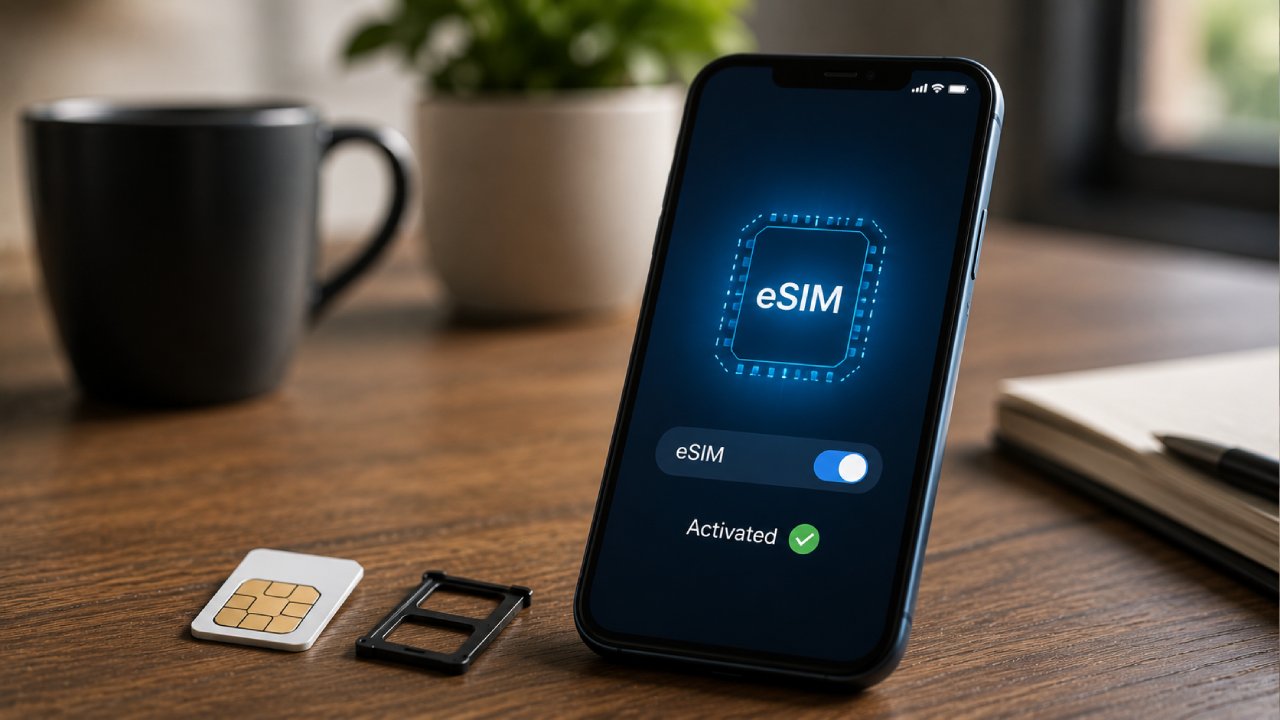
An eSIM, short for embedded SIM, is a digital SIM card built directly into a phone, tablet, or smartwatch that lets a user connect to a mobile network without inserting a physical SIM card. It stores network profiles electronically and downloads them over WiFi or mobile data, replacing the plastic card that has shipped inside phones since the 1990s. Every major UK network, including EE, Vodafone, O2, and Three, now issues eSIM plans on pay monthly, SIM only, and pay as you go tariffs in 2026. Nearly three quarters of UK consumers now recognise the term eSIM, up from just 27% in 2022, and almost a third have already used one to sign up with a provider, according to FDM CCS Insight research published in January 2026. This guide explains what an eSIM is, how an eSIM works, and how to activate one on the network of your choice.
What Is an eSIM?
An eSIM is a small chip built into a device that performs the same job as a removable SIM card, storing the data that identifies a subscriber on a mobile network. The chip itself is called an eUICC, short for embedded universal integrated circuit card, and it sits permanently soldered to the device's circuit board rather than sliding into a tray. The eUICC chip measures less than 2mm (0.08 inches) across, compared to a nano SIM card at 12.3mm by 8.8mm (0.48 by 0.35 inches), freeing up internal space that manufacturers use for larger batteries or slimmer designs.
The Global System for Mobile Communications (GSMA), the global trade body that sets mobile industry standards, created the eSIM specification in 2016 and requires every manufacturer to build to the same profile format. That standard is why an eSIM downloaded from EE behaves identically to one downloaded from Vodafone or O2, since the underlying technology is shared across every UK network.
How Does an eSIM Work?
An eSIM works by downloading an encrypted network profile onto the eUICC chip through a QR code (quick response code), a carrier app, or a manual activation code, then activating that profile so the device connects to the chosen network. The eUICC chip can store several profiles at once, though most phones use only one for calls, texts, and data at any given time. Switching networks means downloading a new profile instead of removing a card, and a user can delete or reinstall a profile without visiting a store. The network authenticates the device using the same SIM authentication keys as a physical card, so signal strength, call quality, and data speed stay identical to a plastic SIM running on the same network.
eSIM vs Physical SIM: What's the Difference?
The main difference between an eSIM and a physical SIM is installation: an eSIM downloads digitally in under 5 minutes, if the device has a WiFi connection, while a physical SIM must be delivered, collected, or removed with a pin tool before it can be inserted. The table below sets out the practical differences a UK customer will notice day to day.
Feature | eSIM | Physical SIM |
Setup | Instant digital download | Requires delivery or in store collection |
Activation | QR code, app, or manual code | Insert card into a SIM tray |
Switching networks | Download a new profile | Order and insert a new card |
Multiple profiles | Several stored, one active | One number per card |
Loss or damage risk | Cannot fall out or be physically damaged | Can be lost, bent, or damaged |
Environmental impact | No plastic or packaging waste | Produces plastic waste per card |
Physical SIM cards remain useful on older devices and for anyone who prefers to move a number between phones without an internet connection. However, eSIM technology suits anyone who upgrades devices often, travels abroad regularly, or wants a second number without carrying two phones.
How to Activate an eSIM
To activate an eSIM, a user needs an eSIM compatible device, a network unlocked handset, and a stable WiFi connection, then follows 5 steps.
Confirm the device supports eSIM by dialling *#06# and checking for an EID number
Order or request an eSIM plan from the chosen UK network
Scan the QR code sent by email or text, or enter the activation details manually
Select the eSIM as the default line for data, calls, or texts
Restart the device to complete activation
Apple publishes step by step setup guides for every eSIM compatible iPhone, and most Android manufacturers, including Samsung and Google, build the same QR code process into their settings menu.
Which Phones Support eSIM in 2026?
Every iPhone from the iPhone XS onward, every Google Pixel from the Pixel 3 onward, and most Samsung Galaxy S and Z series phones released since 2020 support eSIM. Examples of current eSIM compatible handsets include the models below.
Apple: iPhone 17, iPhone 17 Pro, iPhone Air, iPhone 16, iPhone 15, iPhone 14, iPhone 13, iPhone 12, iPhone SE 2020, iPhone 11, iPhone XS, and iPhone XR
Samsung: Galaxy S26, Galaxy S25, Galaxy S24, Galaxy Z Fold7, and Galaxy Z Flip7
Google: Pixel 10, Pixel 10 Pro, Pixel 9, Pixel 8, and Pixel 7
Apple's iPhone Air ships without a SIM tray at all, using eSIM as the only connection option, and the wider iPhone 17 range follows the same eSIM only design in several markets. A user should check a specific model's specification page before buying, since regional variants sometimes differ.
Which UK Networks Offer eSIM?
EE, Vodafone, O2, Three, giffgaff, Smarty, Voxi, and Talkmobile all sell eSIM plans in the UK in 2026, spanning pay monthly, SIM only, and pay as you go tariffs. Pay monthly eSIM contracts typically run for 1, 12, or 24 months, while pay as you go eSIM plans roll on a 30 day cycle and top up automatically.
EE activates eSIM plans through its own app or a QR code emailed after purchase. Vodafone sends a QR code by email and offers Apple Quick Transfer for iPhone to iPhone switches. O2 issues eSIM through its account app for both pay monthly and pay as you go customers. Three supports eSIM on pay monthly and pay as you go SIM only plans across its network. giffgaff, Smarty, and Voxi run on the O2, Three, and Vodafone networks respectively, and each offers eSIM only sign up with no physical card option at all, which keeps their prices below the parent network.
A buyer comparing eSIM contracts should check data allowance, contract length, and network coverage before choosing, and browsing current SIM only deals side by side makes that comparison easier.
5 Benefits of Using an eSIM
Instant activation, connecting within minutes of purchase instead of waiting for delivery
Dual SIM use, running a work number and a personal number on one device
Simplified travel, downloading a local data plan on arrival instead of buying a physical SIM abroad
Reduced SIM swap fraud risk, since the chip cannot be physically removed or cloned
Less plastic waste, since no card or packaging ships to the customer
Are There Any Downsides to an eSIM?
An eSIM carries 5 practical limitations worth knowing before switching.
Not every device supports it, particularly budget Android phones and handsets older than 2018
Losing a phone means contacting the network to suspend the profile remotely, since the eSIM cannot be removed and inserted into a replacement handset
Switching devices needs a fresh profile download in most cases, rather than a quick card swap
A damaged device with a faulty eUICC chip may need a full replacement, since the SIM function is not repairable separately
A locked device blocks eSIM installation entirely, since a network lock prevents any profile, physical or digital, from a different provider
iPhone users moving between 2 eSIM only iPhones can use Apple's Quick Transfer feature to move a profile without contacting the network, though older devices and most Android phones still require a fresh QR code from the network provider.
eSIM and 5G
An eSIM supports 5G exactly like a physical SIM, since SIM technology and network generation operate independently of each other. A 5G capable eSIM plan delivers the same top speeds as a 5G physical SIM on the same network, and the only requirement is a 5G compatible device paired with a 5G enabled tariff. UK networks apply identical 5G coverage and speed to eSIM and physical SIM customers on the same plan.
Frequently Asked Questions
Does an eSIM change your number?
No, transferring an existing number onto an eSIM keeps that number active, and a new eSIM only receives a new number if the customer requests one.
Can I use an eSIM and a physical SIM at the same time?
Yes, most eSIM compatible phones support dual SIM, running an eSIM and a physical SIM side by side with 2 separate numbers active on one device.
Is an eSIM more secure than a physical SIM?
Yes, an eSIM reduces SIM swap fraud because it cannot be physically removed, cloned, or swapped without authorisation from the account holder.
Can I get an eSIM on pay as you go?
Yes, EE, Vodafone, O2, Three, and several smaller UK networks all sell pay as you go eSIM plans that top up automatically on a rolling 30 day cycle.
How do I activate an eSIM on an iPhone?
To activate an eSIM on an iPhone, open Settings, select Mobile Service or Cellular, tap Add eSIM, then scan the QR code or enter the activation details manually.
What happens if I lose a phone with an eSIM installed?
Losing a phone with an eSIM means contacting the network provider immediately to suspend the profile remotely, then requesting a replacement eSIM for a new device using the same account.
How much does an eSIM cost in the UK?
An eSIM itself costs nothing extra, since UK networks charge the same price for an eSIM as a standard SIM only plan, with prices in 2026 starting from around £5 to £10 a month for a small data allowance.
Is eSIM Only the Future for UK Phones?
Yes, eSIM only devices are becoming the standard direction for UK phones, led by Apple's decision to sell the iPhone Air and parts of the iPhone 17 range without a SIM tray. The global eSIM market reached a value of roughly $11.9 billion in 2025 and is projected to grow to $12.8 billion in 2026, driven largely by smartphone adoption alongside connected cars, tablets, and smartwatches. Manufacturers gain 3 practical advantages from dropping the SIM tray: extra internal space for a larger battery, one less moving part that can let in dust or water, and lower production cost across millions of units. UK networks have responded by building eSIM into every new SIM only and pay monthly plan, so a customer buying an eSIM only phone in 2026 will find full support across EE, Vodafone, O2, and Three.
Final Thoughts
An eSIM replaces the plastic SIM card with a digital profile stored on a device's built in chip, and UK networks now support the technology across every major contract type. Anyone with a compatible phone can switch from a physical SIM to an eSIM in minutes, without waiting for a new card to arrive. Compare current SIM only deals to find an eSIM ready plan that matches your data needs and budget, or check the latest phone deals if a new device is part of the switch.