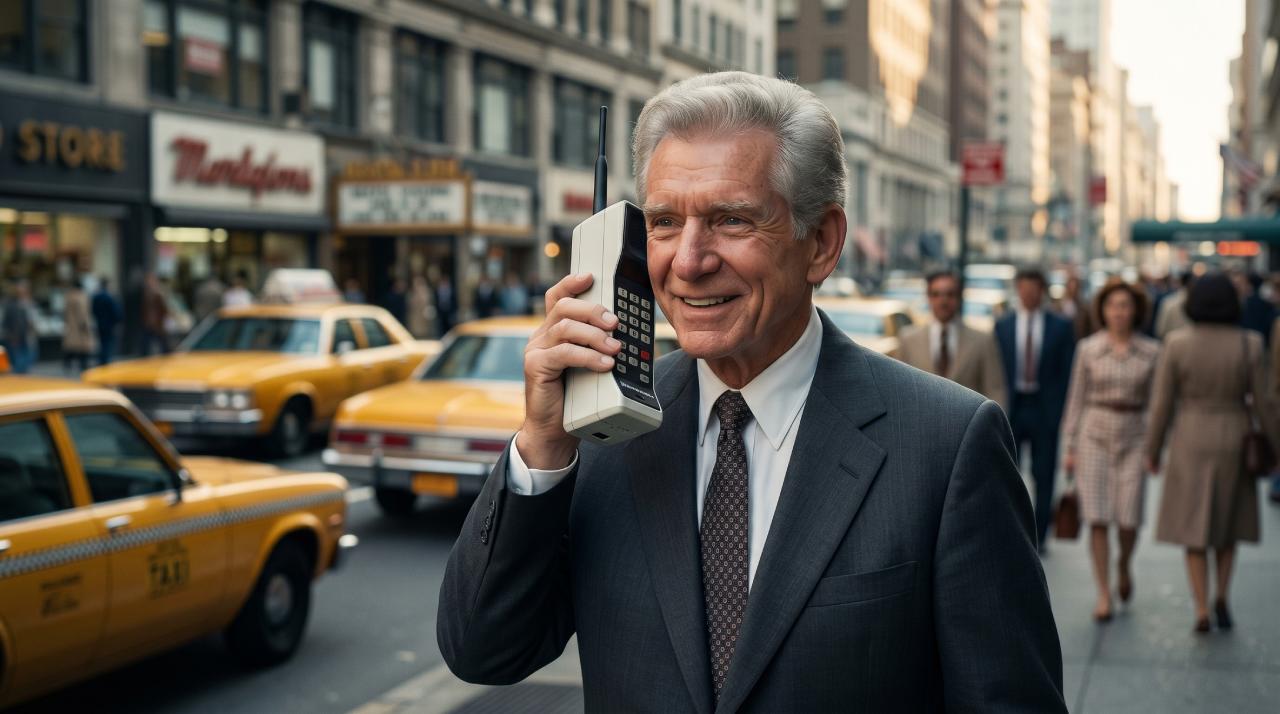
The first mobile phone was invented on 3 April 1973, when Martin Cooper a senior engineer at Motorola made a handheld cell phone call on a pavement in New York City. The device weighed 1.1 kg (2.5 lbs), took 10 hours to charge, and gave you 30 minutes of talk time. It had no screen, no texting, and no voicemail. It was, by any measure, absurd. And it changed everything.
But that single call in 1973 is only part of the story. The mobile phone didn't arrive fully formed. It took 40 years of failed experiments, competing patents, and commercial gambles before the first mobile phone went on sale and another 24 years before the smartphone made all of that look primitive. This is the complete history, including what competitors often miss: the UK's specific role, the engineers who never get credit, and what actually happened decade by decade.
What Was the Very First Mobile Phone?
The first handheld mobile phone was the Motorola DynaTAC prototype (1973). The first commercially sold mobile phone was the Motorola DynaTAC 8000X (1983), priced at $3,995 roughly £3,000 in the UK at launch in 1985.
The distinction matters. Cooper's 1973 call proved the concept. It took Motorola 10 more years of engineering before the DynaTAC 8000X was small enough, reliable enough, and safe enough for the public. Even then, the first version stood 33 cm (13 inches) tall and stored only 30 phone numbers. The waiting list ran into the thousands despite the price.
So: the mobile phone was invented in 1973. But the first mobile phone you could actually buy didn't exist until 1983.
Who Invented the Mobile Phone? (It Wasn't Just One Person)
Most articles credit Martin Cooper and stop there. That's incomplete. 3 separate teams built the foundations without which Cooper's call would never have been possible:
W. Rae Young & Douglas Ring (Bell Labs, 1947) published the theoretical framework for hexagonal cell towers. Every mobile network on earth still uses this geometry.
Amos Joel Jr (Bell Labs, 1970) invented the automated handoff system that switches your call between cell towers as you move. Without this, mobile phones only worked in one spot.
Martin Cooper (Motorola, 1973) built the first working handheld device and placed the first public mobile phone call. Widely called the father of the mobile phone.
Cooper made his call to Joel Engel his direct rival at Bell Labs, who was also racing to build the first cell phone. The call was partly a demonstration, partly a provocation. Bell Labs had been lobbying the FCC to assign mobile spectrum only to AT&T's car-phone system. Cooper's call, made on a public New York street, was his argument that handheld devices were real and ready.
The Complete History of Mobile Phones: 1920s to 2025
This is a decade-by-decade account of how the mobile phone evolved with context that most timeline articles leave out.
1920s–1940s: Radios That Could Make Calls
Mobile telephony began not with phones but with radios. In 1926, Deutsche Reichsbahn (German state railways) offered the first mobile telephone service to first-class passengers on the Berlin–Hamburg line a handset connected via radio to the public exchange. In 1946, AT&T launched the first US commercial car radiotelephone service in St Louis. The entire city shared 3 radio channels, handling 3 simultaneous calls at once. Demand swamped capacity within months.
These weren't cell phones. They used a single powerful transmitter covering a wide area, not a network of cells. You couldn't move between areas and keep your call. But they proved one thing: people wanted mobile communication badly enough to pay for it.
1956: Sweden Gets the First Automated Mobile System
Ericsson launched the MTD (Mobiltelefonisystem D) in Sweden the world's first automated mobile phone system for private vehicles. It had 125 subscribers between Stockholm and Gothenburg. The handset was installed in the car boot and weighed 40 kg (88 lbs). To make a call, you spoke to a manual operator who physically plugged in the connection. When you drove out of one coverage zone, your call dropped. Automatic handoff between zones wouldn't exist for another two decades.
1973: The First Mobile Phone Call
On 3 April 1973, Martin Cooper walked out of the Motorola lab in New York, stood on 6th Avenue, and dialled Joel Engel at Bell Labs on the DynaTAC prototype. The call lasted a few minutes. Passersby stopped and stared they'd never seen anyone on the phone in the street before. Cooper later said Engel went silent on the other end when he realised what he was hearing.
The DynaTAC prototype: 228.6 mm tall, 127 mm wide, 44.4 mm deep, 1.1 kg. Charge time: 10 hours. Talk time: 30 minutes. After the call, it was back in the lab for another 10 years of refinement before it was ready for sale.
1983: The First Mobile Phone Goes On Sale
The Motorola DynaTAC 8000X received FCC approval on 21 September 1983 and went on sale in the US at $3,995 (equivalent to around $12,500 / £9,800 today). It weighed 793 g (28 oz), offered 30 minutes of talk time per charge, and stored 30 numbers. It had an LED display but no screen, no text messaging, and no data. Nokia's Mobira Senator a car phone at 9.8 kg had launched in 1982, making it technically the first Nokia mobile, though not handheld.
Despite the price, thousands of people joined the waiting list. The concept of a phone you could carry anywhere was worth £3,000 to a specific kind of person: the kind who needed to be reachable, and had the money to prove it.
1985: The First Mobile Phone Call in the UK
On 1 January 1985, comedian Ernie Wise made the first public mobile phone call in the UK from outside the Dickens Pub at St Katharine Docks, London, to Vodafone's headquarters. The handset was the DynaTAC 8000X, priced at £3,000. Two networks launched that day: Vodafone and Cellnet (now O2). The UK had 1G mobile coverage analogue, voice-only, and patchy but the mobile phone era had begun.
1991–1992: GSM, SIM Cards, and the World's First Text
The GSM (Global System for Mobile Communications) standard launched commercially in Finland in 1991. GSM was a fundamentally different approach to mobile: digital rather than analogue, built around interoperability between countries, and secured with a SIM (Subscriber Identity Module) card. Every text message, every overseas roaming call, every number port since 1991 has run on this foundation.
On 3 December 1992, Neil Papworth a 22-year-old developer at Sema Group sent the world's first SMS from a PC to Richard Jarvis at Vodafone. It read: "Merry Christmas". Papworth sent it from a computer because mobile phones at the time had no keyboard. It took several more years before SMS became mainstream. Most networks didn't charge for texts until they noticed people were sending them by the million.
1996–1999: Phones Become Fashionable
By 1996, UK mobile ownership stood at 16% of households. A decade later it was 80%. Several products drove that shift:
Motorola StarTAC (1996): The first clamshell phone, weighing just 88 g (3.1 oz). The first phone marketed openly as a luxury item. Priced at around £700 in the UK.
Nokia 6110 (1997): Made SMS mainstream. First phone with Snake. Nokia sold 40.8 million handsets in 1998 alone becoming the world's largest phone manufacturer.
Nokia 7110 (1999): First phone with a WAP (Wireless Application Protocol) browser. Early mobile internet text-only, slow, awkward but a genuine first.
BlackBerry 850 (1999): Introduced the QWERTY keyboard and push email for business users. Within a decade, RIM was one of the fastest-growing companies on earth.
2000–2002: Camera Phones and Colour Screens
Nokia launched the 3310 in 2000, selling 126 million units one of the best-selling phones of all time. It introduced customisable ringtones, a vibrate mode, and a sturdiness that became legendary. The same year, Sharp launched the J-SH04 in Japan the first mass-market camera phone, with a 0.11 MP sensor. Europe got camera phones in 2002 with the Nokia 7650. Siemens had already launched the first colour-screen phone the S10 in 1998.
2003: 3G Arrives in the UK
Three (Hutchison 3G) launched the UK's first 3G network in March 2003. 3G (third generation) brought mobile internet at speeds up to 384 kbps roughly 40 times faster than GPRS. It launched with 3 handsets: the Motorola A830, NEC e606, and NEC e808. Mobile internet was now genuinely usable for the first time, though coverage was patchy outside major cities for several years.
2007: The iPhone and the End of Every Other Phone
Steve Jobs announced the original iPhone on 9 January 2007. It launched in the UK on 9 November 2007 through O2, at £269 on an 18-month contract. There was no App Store, no 3G, no MMS. What it had was a capacitive touchscreen, a full desktop-class web browser, and an interface that made every other phone on the market feel like a step backwards.
Nokia's CEO publicly dismissed it. Palm, BlackBerry, and Microsoft all said smartphones already existed. They were correct but they'd misread what people actually wanted. Within 7 years, Nokia had sold its phone business. BlackBerry's consumer market had collapsed. The iPhone had not invented the smartphone, but it had defined what a smartphone should feel like.
2008: Android and the App Economy
HTC launched the T-Mobile G1 (HTC Dream) in October 2008 the first Android phone. It had a physical keyboard, a 3.2-inch touchscreen, and ran Android 1.0. In the same year, Apple launched the App Store with 500 apps and Google launched Android Market (later Google Play). The dual-platform smartphone economy was established. By 2025, the App Store hosts over 1.8 million apps and Google Play over 2.6 million.
2012: Peak SMS, 4G Arrives
UK mobile users sent 151 billion text messages in 2012 the highest total ever recorded, and the last year texts outnumbered data messages. That same year, EE launched the UK's first 4G LTE network in October 2012, initially across 11 UK cities. 4G brought download speeds averaging 20–30 Mbps, making HD video streaming on a phone realistic for the first time.
2019: 5G Launches in the UK
EE launched 5G (fifth generation) mobile in May 2019 across parts of London, Birmingham, Cardiff, Edinburgh, Belfast, and Manchester. 5G offers theoretical peak speeds of up to 10 Gbps approximately 100 times faster than 4G. By 2025, UK 5G coverage extended to over 60% of the population across all 4 main networks: EE, Vodafone, O2, and Three.
2023–2025: AI Phones and Foldables
The most recent shift in mobile phone history isn't hardware it's intelligence. Samsung's Galaxy S24 series (2024) introduced on-device AI features including live call translation and photo editing that generates missing parts of images. Apple launched Apple Intelligence with iOS 18.1 in October 2024, bringing writing tools, Siri upgrades, and image generation directly on device.
Foldable phones moved from novelty to genuine category. Samsung's Galaxy Z Fold and Z Flip ranges, Google's Pixel Fold, and OnePlus's Open all reached mainstream availability in the UK. Global foldable phone sales crossed 20 million units in 2024, still a small share of the overall market but growing faster than any other segment.
Mobile Network Generations: 1G to 5G Explained
Each generation of mobile network brought faster speeds and new types of use. Here's what each one actually changed:
1G (1979, UK 1985): Analogue voice only. No texts, no data. Calls were unencrypted scanners could intercept them. Coverage was thin and unreliable.
2G / GSM (1991, UK 1992): Digital voice, SIM cards, SMS. Encrypted calls. International roaming. This is the generation that turned mobile phones from a luxury into a utility.
3G (2001, UK 2003): Mobile internet, video calls, email. Speeds up to 384 kbps initially. Enabled the first smartphones to work as intended.
4G LTE (2009, UK 2012): Broadband-speed data on a phone. 20–100 Mbps typical speeds. Made streaming, video calls, and social media usable on mobile.
5G (2019, UK 2019): Ultra-low latency, up to 10 Gbps theoretical. Designed as much for IoT (Internet of Things) devices as for handsets.
When Was the First Mobile Phone Used in the UK?
The first mobile phone was used publicly in the UK on 1 January 1985. But the UK's role in mobile phone history goes further than that single date:
1985: Vodafone and Cellnet (now O2) launch the first UK mobile networks.
1992: The world's first SMS is sent from the UK, by Neil Papworth on the Vodafone network.
1999: UK 16% household mobile ownership. Vodafone Prepaid launches the first UK pay-as-you-go service in 1996.
2003: Three launches the UK's first 3G network.
2012: EE launches the UK's first 4G network. UK sends a record 151 billion texts.
2019: EE launches 5G. UK is among the first 10 countries globally with commercial 5G service.
Today, over 92% of UK adults own a smartphone, according to Ofcom's 2024 Communications Market Report. The average UK adult spends over 4 hours per day on their phone. The mobile phone has become the primary computer for most people in this country faster than broadband in many rural areas, more personal than a laptop, and with them every waking hour.
The 6 Most Important Mobile Phones in History
Not every phone matters equally. These 6 changed what was possible:
Motorola DynaTAC 8000X (1983): The first. 793 g, $3,995, 30 minutes of talk time. Proved handheld mobile phones could be a commercial product.
Nokia 6110 (1997): Made SMS mainstream. First phone with Snake. More than any other device, it turned mobile phones from a business tool into a consumer product.
Nokia 3310 (2000): 126 million units sold. Democratised mobile phones in the UK and Europe. Still referenced in memes today for its indestructibility.
BlackBerry 850 (1999): Brought email to mobile phones for the first time. Defined how businesses communicated for a decade.
Apple iPhone (2007): Capacitive touchscreen, full web browser, app platform. Redefined what a phone was for.
Samsung Galaxy S (2010): Proved Android could match iOS in build quality and sales. Created the competitive pressure that drove smartphone improvement throughout the 2010s.
Looking for the best mobile phone deals in the UK right now? See our mobile phone deals page, or compare SIM-only deals if you already own a handset. For network coverage maps and contract guides, visit Ofcom's mobile coverage checker.
Frequently Asked Questions
When was the first mobile phone invented?
The first mobile phone was invented in 1973, when Martin Cooper at Motorola built and demonstrated the DynaTAC prototype. The first commercially sold mobile phone the Motorola DynaTAC 8000X went on sale in the US in 1983 at $3,995.
Who made the first mobile phone?
Martin Cooper of Motorola made the first handheld mobile phone call on 3 April 1973. The underlying network technology hexagonal cell tower layout and automatic handoff between towers was developed by engineers at Bell Labs in the 1940s and 1970s.
What was the first mobile phone ever sold?
The Motorola DynaTAC 8000X was the first commercially sold mobile phone, launched in the US in 1983 at $3,995. It weighed 793 g, offered 30 minutes of talk time per charge, and stored 30 numbers. The FCC approved it on 21 September 1983.
When were mobile phones invented in the UK?
Mobile phones became available in the UK on 1 January 1985, when Vodafone and Cellnet (now O2) launched as the UK's first 2 mobile networks. The first UK call was made by Ernie Wise on the Vodafone network using a Motorola DynaTAC 8000X, priced at £3,000.
When was the first smartphone invented?
The IBM Simon Personal Communicator (1994) is widely considered the first smartphone. It had a touchscreen, email, calendar, and fax capability. The modern smartphone era with apps, mobile internet, and touchscreen-first design started with the Apple iPhone in 2007.
What was the first mobile phone with internet access?
The Nokia 7110 (1999) was the first mass-market mobile phone with internet access via a WAP browser. An earlier device, the Nokia 9000 Communicator (1996), also had internet access but was a niche product. Full mobile internet comparable to desktop browsing arrived with 3G smartphones in 2003.
When was the first cell phone invented compared to the first smartphone?
The first cell phone was invented in 1973 (DynaTAC prototype) and first sold in 1983. The first smartphone was the IBM Simon in 1994. The modern smartphone app-based, touchscreen-first arrived with the iPhone in 2007. That's a 34-year gap between the first mobile phone call and the device most people picture when they hear the word 'smartphone' today

.jpg)