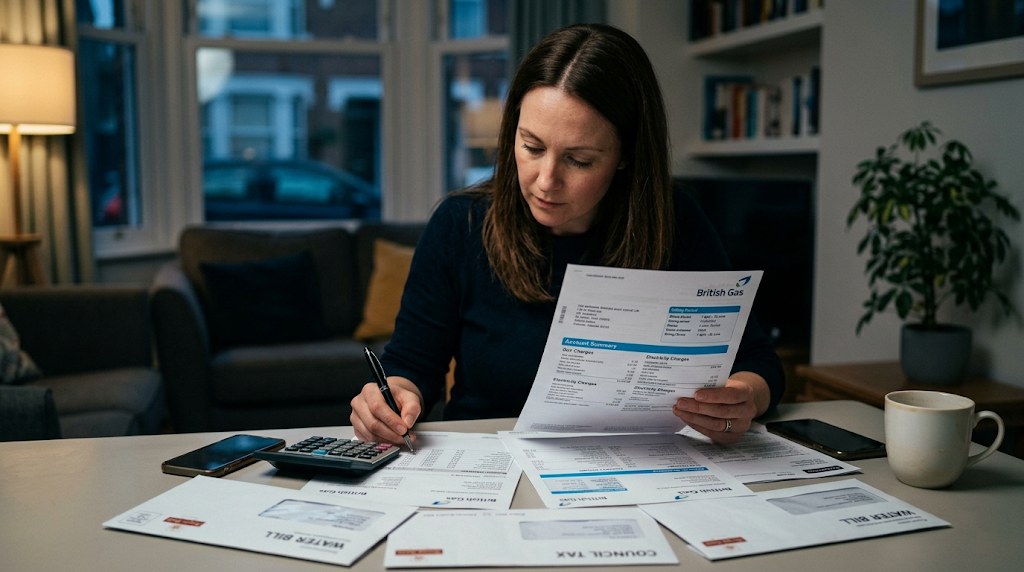
A utility bill is a regular charge for an essential home service, typically electricity, gas, or water. In the UK, utility bills arrive monthly or quarterly by post or email, showing your usage and the amount you owe. Most people also receive broadband and council tax bills, which are closely related but not classed as traditional utilities.
This guide explains exactly what counts as a utility bill, how each one works, what's on them, and how to use them as proof of address with clear UK examples throughout.
What Counts as a Utility Bill in the UK?
3 services are universally accepted as utility bills in the UK: electricity, gas, and water/sewerage. These are essential services every household needs, regulated by Ofgem (energy) and Ofwat (water).
Here is a breakdown of each:
Bill Type | Provider Examples | Regulator | Billing Frequency |
Electricity | Octopus Energy, British Gas, E.ON Next, EDF | Ofgem | Monthly or quarterly |
Gas | British Gas, OVO Energy, ScottishPower | Ofgem | Monthly or quarterly |
Water & Sewerage | Thames Water, Welsh Water, Severn Trent | Ofwat | Every 6 months |
Broadband | BT, Virgin Media, Sky, Plusnet | Ofcom | Monthly |
Council Tax | Your local council | Central/Local Govt | Monthly (10 instalments) |
Broadband and council tax are not traditional utilities, but most banks, landlords, and institutions accept them as proof of address.
What Is on a Utility Bill?
Every UK utility bill contains a standard set of information. Knowing what to look for helps you spot errors and manage your household budget accurately.
Account holder name and address must match your registered details exactly
Account number used when contacting your supplier
Billing period: the dates your charges cover
Meter readings, actual or estimated, are shown in kWh for energy
Unit rate and standing charge the two main components of your energy cost
VAT is charged at 5% on domestic energy bills
Total amount due and payment date, and how much you need to pay
Supplier contact details, phone number, website, and complaints process
For energy bills, the standing charge covers the cost of keeping you connected to the grid, regardless of how much you use. It is measured in pence per day (p/day).
What Makes Up the Cost of an Energy Utility Bill?
Your energy utility bill is not just one cost it has 6 main components. Understanding each one helps you see where your money goes.
Wholesale Energy Costs
Wholesale costs make up roughly 35% of your bill. This is what your supplier pays to buy gas and electricity from producers. Prices shift with global demand, weather patterns, and international events, which is why bills rose sharply from 2021 to 2023.
Network (Transmission and Distribution) Costs
Network costs cover the pipes and cables that carry energy to your home. They account for around 25% of a typical bill. This money funds maintenance, upgrades, and the infrastructure that keeps the grid stable.
Social and Environmental Obligations
Suppliers pass on costs from government schemes through your bill. These currently include:
Warm Home Discount (WHD) one-off £150 rebate for eligible low-income households
Great British Insulation Scheme (GBIS) funding for home insulation upgrades
Feed-in Tariff (FIT) payments to households generating solar energy
Priority Services Register (PSR) support for vulnerable customers
The Energy Company Obligation (ECO) scheme is being removed from April 2026, as confirmed in the government's autumn 2025 budget. These obligations add roughly 10–12% to your total bill.
Operating Costs
This covers the supplier's day-to-day running costs, customer service teams, meter reading, billing systems, and administration. It makes up around 15% of your bill.
Supplier Margin (Profit)
Suppliers retain a small pre-tax profit margin, typically 1–2% on residential accounts. Ofgem monitors this closely as part of its price cap framework.
VAT
VAT on domestic energy is 5% below the standard 20% rate. It applies to both the unit rate and the standing charge.
Utility Bills as Proof of Address in the UK
Yes, a utility bill is widely accepted as proof of address in the UK. Banks, letting agents, universities, HMRC, and solicitors all regularly ask for one.
To be valid as proof of address, your utility bill must show:
Your full legal name
Your current home address
A date within the last 3 months
The name and logo of a recognised provider
5 utility bills accepted as proof of address in the UK:
Thames Water or Severn Trent water bill
British Gas or Octopus Energy electricity or gas bill
Virgin Media or BT broadband bill
Council tax bill from your local authority
TV Licence bill
Mobile phone bills are not usually accepted for higher-level identity checks, as they are considered less reliable for address verification. Always check the specific requirements of the organisation asking for the document.
What If You Don't Have a Utility Bill in Your Name?
This is common in house shares, student lets, or properties where bills are included in rent. In these cases, you can use:
A recent bank statement (within 3 months)
A council tax bill
An HMRC letter or tax notification
A valid UK driving licence
An official government letter
If you're moving home, getting at least one utility set up in your name as early as possible makes future address checks much simpler.
Do Utility Bills Affect Your Credit Score?
Paying utility bills on time does not automatically improve your credit score. In most cases, on-time payments for electricity, gas, and water are not shared with credit reference agencies such as Experian, Equifax, or TransUnion.
However, there are 3 important exceptions:
Missed payments can hurt your score. Most UK suppliers report missed payments to credit agencies after 30 days. Persistent non-payment can result in a County Court Judgment (CCJ), which stays on your credit file for 6 years.
Experian Boost and similar services. These optional tools let you register utility payments to support your credit profile. The benefit is limited to that provider's own scoring system, not across all lenders.
Broadband and mobile contracts involve credit checks. Applying for these services often triggers a hard credit search, which stays on your file and can temporarily reduce your score.
Space out new service applications where possible to limit the impact on your credit history.
Is Council Tax a Utility Bill?
No, council tax is not a utility bill it is a statutory charge levied by your local council to fund local services such as refuse collection, schools, and emergency services. However, most organisations accept council tax bills alongside utility bills as valid proof of address.
Council tax is charged in 10 monthly instalments (April to January), with bands ranging from A (lowest) to H (highest) based on your property's assessed value. Students in full-time education are exempt. Single occupants receive a 25% discount.
Missing council tax payments is serious; local councils can pursue enforcement action faster than energy suppliers. If you're struggling, contact your council to discuss a Council Tax Reduction (CTR), a means-tested discount available in every local authority area in England, Scotland, and Wales.
How to Reduce Your Utility Bills in the UK
There are 6 proven ways to lower your household utility costs without changing your lifestyle significantly:
Compare and Switch Energy Tariffs
The energy price cap limits what suppliers can charge per unit, but fixed-rate tariffs can sometimes offer better value. Use a comparison of energy deals. Switching takes around 21 days and costs nothing.
Submit Accurate Meter Readings
Estimated readings often lead to overpayment. Submit a reading every month or get a smart meter installed for automatic readings. Smart meters are free to install through your supplier.
Apply for the Warm Home Discount
The Warm Home Discount gives eligible households a £150 rebate off their electricity bill. The scheme runs from October to March each year. You qualify automatically if you receive the Guarantee Credit element of Pension Credit.
Reduce Heating Costs
Lowering your thermostat by just 1°C can cut your heating bill by up to £110 per year, according to the Energy Saving Trust. Draught-proofing, loft insulation, and bleeding radiators all make a measurable difference to your gas bill.
Switch to LED Lighting
Replacing all bulbs with LED alternatives saves at least £4 per bulb per year. LEDs last up to 25 times longer than traditional incandescent bulbs and use around 75% less electricity.
Check Eligibility for Energy Grants
If you're on a low income or receive certain benefits, you may qualify for free insulation or boiler replacement under the Great British Insulation Scheme (GBIS). Check gov.uk or contact your local council.
Frequently Asked Questions About Utility Bills
What is classed as a utility bill in the UK?
Electricity, gas, and water bills are the 3 core utility bills in the UK. Broadband, council tax, and TV Licence bills are not technically utilities but are widely accepted as substitutes for them for most administrative purposes.
Is broadband a utility bill?
No, broadband is not classified as a utility bill; it is a telecommunications service regulated by Ofcom, not Ofgem or Ofwat. However, most banks and landlords accept broadband bills as proof of address, and the ONS includes broadband in its cost-of-living calculations.
How recent does a utility bill need to be for proof of address?
Your utility bill must be dated within the last 3 months to be accepted as valid proof of address. Some organisations, such as financial institutions conducting KYC (Know Your Customer) checks, may require a bill dated within the last 30 days.
Can I use an online or paperless utility bill as proof of address?
Yes, digital and paperless bills are accepted as proof of address in most cases. Print a copy directly from your online account or download the PDF. The document must clearly show your name, address, provider name, and a recent date. Some solicitors or notaries may ask for the original to be certified.
What is a standing charge on a utility bill?
A standing charge is a fixed daily fee for keeping your property connected to the energy network, regardless of how much energy you use. It is measured in pence per day (p/day) and covers network maintenance, metering, and supplier operating costs. As of 2025, typical standing charges range from 45p to 65p per day for electricity and 27p to 32p per day for gas.
Does paying a utility bill build credit?
Not automatically. Standard on-time payments for electricity, gas, and water are not reported to credit reference agencies. However, missed payments can be reported to credit bureaus after 30 days and can damage your credit score. Services like Experian Boost allow you to voluntarily register utility payments to support your credit profile.
What happens if I don't pay my utility bills?
Your supplier will contact you, add late payment charges, and may issue a default notice. For energy, suppliers must follow Ofgem's debt rules before disconnecting a property. Water companies cannot legally disconnect domestic properties in England and Wales. However, persistent non-payment can result in debt collection action and a County Court Judgment (CCJ) on your credit file for 6 years.


.jpg)