
Last updated: Wednesday 11 November 2026 (Europe/London)
Best Broadband Social Tariff Deals in 2026
Compare the current broadband social tariff deals from the biggest UK providers below. Prices and speeds change through the year, so confirm the live price on the provider's own page before you sign up.
BT Full Fibre 150 — £25.99 a month through our link, £0 activation
- BT Full Fibre 150 is £25.99 a month through our link, as of 11 November 2026 (£30.99 on bt.com), on a 24-month contract, then £29.99 from March 2027 and £33.99 from March 2028. If you join in November 2026, your first 12 months cost £339.88: five months at £25.99, then seven at £29.99.
- £0 activation, plus up to £300 towards your old provider’s leaving fees, paid as bill credit. If you join in November 2026, 24 months cost £727.76: five months at £25.99, then 12 at £29.99 and seven at £33.99.
- Main limitation: this is BT’s standard Full Fibre 150 deal, not a social tariff. If you get Universal Credit or another qualifying benefit, BT Home Essentials starts from £16.50 a month on bt.com, as of 11 November 2026. We may earn a commission if you buy through our links; it doesn’t change the price you pay.
Provider (tariff) | Monthly price | Download speed | Contract |
BT Home Essentials | From £16.50 (as of 11 November 2026) | 36Mbps / 67Mbps | Rolling monthly |
Virgin Media Essential Broadband | £12.50 | 15Mbps | Rolling monthly |
Sky Broadband Basics | £20 | 36Mbps | 12 months, existing Sky customers only |
Vodafone Essentials | £20 | up to 73Mbps | Rolling monthly |
Community Fibre Essential | £12.50 | 20Mbps (London only) | Rolling monthly |
Hyperoptic Fair Fibre | £15 | 50Mbps (supported buildings only) | Rolling monthly |
Choose Hey!Broadband Everyday Fibre at £19 a month
- 100Mbps social tariff full fibre for £19 a month on a 12-month contract, as of 11 November 2026
- No price increase during the contract, plus free router and standard installation
- For people on Universal Credit, Pension Credit and some other benefits; check the eligibility list on Hey!Broadband’s page
TalkTalk runs a separate scheme alongside its regular low-cost tariff: 6 months of free broadband for jobseekers actively looking for work. After the free period ends, the account rolls onto a standard low-cost plan unless you cancel it.
Compare these prices against your current bill on our broadband comparison page before you switch, since some standard contracts already sit close to social tariff pricing once a loyalty discount runs out.
How to Apply for a Broadband Social Tariff Deal
To apply, contact your current provider first and ask for its social tariff by name. Most switches complete within a week using this process:
Check your qualifying benefit against the provider's own eligibility list.
Confirm your identity and benefit status, usually with your National Insurance number.
Agree the new monthly price and the date your existing contract ends, if you're mid-contract.
Switch to a different provider using Ofcom's One Touch Switch process if your current provider doesn't offer a social tariff; your new provider cancels the old contract for you.
Read our Universal Credit broadband switching guide for a provider-by-provider breakdown of application steps.
What You Need Before You Apply
Have these three items ready before you call or apply online:
Your National Insurance number, so the provider can verify your benefit in real time.
Your account number or a recent bill, if you're switching within the same provider.
Your postcode, since speed and availability vary by building on tariffs like Community Fibre Essential and Hyperoptic Fair Fibre.
Most providers confirm eligibility within minutes using the Department for Work and Pensions (DWP) benefit-checking service, so you rarely need to send proof of your benefit separately.
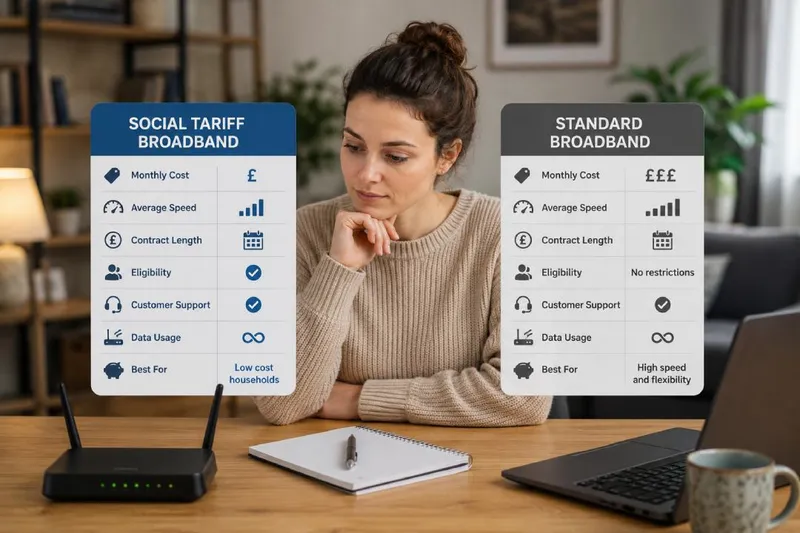
Social Tariff Broadband Compared to Standard Broadband
A social tariff saves £150 to £230 a year against the average standard UK broadband package. If your current deal is out of contract, the saving grows further, since out-of-contract customers often pay £45 to £50 a month for a speed tier that a £15 to £20 social tariff already covers.
Speed matters less than most households expect for everyday use. A 36Mbps connection supports 4K streaming, video calls and 5 to 6 connected devices at once without buffering. A household of 2 or 3 people streaming, browsing, and working from home typically needs 30 to 50Mbps, well within reach of every social tariff on this list except Virgin Media Essential Broadband's 15Mbps tier, which suits 1 or 2 devices at a time.
Why Millions of Eligible Households Miss Broadband Social Tariff Deals
Ofcom estimates 4.2 million UK households qualify for a social tariff, yet take-up sits below 5%. Three gaps explain most of the shortfall:
Awareness. Providers rarely advertise social tariffs alongside their standard deals, so customers don't see the option at sign-up.
Stigma. Some customers avoid asking about a benefits-linked discount out of embarrassment, even though the application only needs a National Insurance number check.
Assumed lock-in. Many customers assume moving mid-contract triggers an exit fee, but most providers let existing customers move to their own social tariff without one.
Providers have little commercial incentive to promote a tariff priced 40 to 60% below their standard packages, so the gap tends to close only through independent guides, Citizens Advice, and word of mouth rather than provider marketing. Checking eligibility costs nothing and takes under 10 minutes, so there's little downside to asking even if you're not certain your benefit qualifies.
Common Mistakes to Avoid When Switching to a Social Tariff
Four mistakes cost eligible households money or delay their switch:
Waiting for the current contract to run out. Most providers let you move to a social tariff mid-contract without an exit fee, so there's no reason to wait if you already qualify.
Applying through a comparison site instead of the provider. Social tariffs sit outside standard comparison feeds, so you apply directly on the provider's own site or by phone.
Assuming PIP or Attendance Allowance always qualifies. These two benefits only count at some providers, so confirm the list before you cancel your existing package.
Overlooking the phone-only social tariffs. BT and KCOM run separate discounted landline-only tariffs for eligible households that don't need broadband, worth checking if you only need a phone line.
Do Social Tariffs Cover Mobile and Phone Bills Too?
Some networks extend the same discount principle to mobile. EE and Vodafone signpost eligible customers toward reduced SIM-only tariffs, and several mobile virtual network operators run their own low-cost data plans for benefit claimants. These sit alongside home broadband social tariff deals rather than replacing them, so a household can hold a discounted broadband line and a discounted mobile SIM at the same time.
Broadband Deals for Pensioners on a Low Income
Pension Credit qualifies pensioners for the same broadband social tariff deals as working-age claimants. BT Home Essentials, Virgin Media Essential Broadband and Vodafone Essentials all accept Pension Credit as a qualifying benefit, at the same prices Universal Credit claimants pay: £12.50 to £20 a month, with BT Home Essentials from £16.50 as of 11 November 2026.
Check your entitlement to Pension Credit itself first, since roughly 760,000 eligible pensioners in the UK don't claim it, according to gov.uk. Claiming Pension Credit can unlock a broadband social tariff on top of the benefit's other entitlements, including help with Council Tax and heating costs.
A pensioner switching from an average £32 out-of-contract broadband bill to a £12.50 social tariff saves roughly £234 a year, money that covers 3 to 4 months of a typical energy bill at current prices. Sky Broadband Basics and BT Home Essentials both accept Pension Credit without a separate application for the broadband discount once the benefit itself is confirmed.
Check Virgin Media Essential Broadband at your address
- Social tariff broadband from £12.50 a month on a rolling 30-day contract, as of 11 November 2026
- Free setup; eligibility is confirmed with the Department for Work and Pensions
- Check the benefits list and your postcode on Virgin Media’s page
Frequently Asked Questions
Do you qualify for a broadband social tariff deal on Universal Credit?
Yes. Universal Credit qualifies you for a social tariff at every major UK provider, including BT, Virgin Media, Sky, Vodafone, Community Fibre and Hyperoptic. You apply directly with the provider and confirm your benefit through your National Insurance number.
Can you get a broadband social tariff deal without a credit check?
Yes, at most providers. Virgin Media Essential Broadband and BT Home Essentials both skip the standard credit check, since eligibility runs on your benefit status rather than your credit score.
Do broadband social tariff deals include line rental?
Most include line rental in the price. BT Home Essentials, Virgin Media Essential Broadband and Vodafone Essentials all bundle the phone line into the monthly fee, so there's no separate charge to budget for.
Can you switch to a social tariff mid-contract?
Usually yes. If you move to a social tariff with your current provider, most let you do it mid-contract without an exit fee. If you move to a different provider, your old provider can still charge early termination fees; One Touch Switch only means your new provider arranges the move and the cancellation for you.
How much do broadband social tariff deals save each year?
Around £150 to £230 a year. The average standard UK broadband package costs roughly £32 a month (£384 a year) in 2026. A social tariff at £12.50 to £20 a month brings the annual cost down to £150 to £240, a saving of £150 to £230 depending on the provider and speed you pick.
Do social tariffs rise in price during the contract?
No, in almost every case. Social tariffs are exempt from the mid-contract, inflation-linked price rises that hit standard broadband deals every April. If a provider does plan a rise, rules in force since 17 January 2025 require it to state the exact amount in pounds and pence before you sign.
Is there free broadband for people on Universal Credit?
Not as a permanent deal, but TalkTalk offers 6 months of free broadband for jobseekers actively looking for work, separate from its ongoing social tariff. After the free period ends, the account moves to a standard low-cost plan unless you cancel.
For more ways to cut your household bills in 2026, see our full guide to Universal Credit discounts, or read Citizens Advice for wider support if you're behind on any household bill.