Last updated: Friday 11 September 2026 (Europe/London).
11 September 2026 refresh: UK broadband types in 2026 still split into ADSL copper, part-fibre (FTTC/SoGEA), full fibre (FTTP), cable (DOCSIS), and fixed wireless / 5G home. Full fibre is the long-term default where available — check your postcode before you chase a national “from £” tile. Compare live packages on our broadband hub — do not treat old pound figures in this guide as live checkout prices.
The UK has five main types of broadband: ADSL, FTTC, FTTP, cable and 5G home broadband. Each option uses different infrastructure, delivers different speeds, and covers different parts of the country. Openreach's full fibre network now reaches most homes, so knowing your types of broadband options helps you pick the fastest connection at your address. This guide breaks down every broadband type, compares speeds and coverage, and shows how to check what's available at your postcode.
What Is Broadband?
Broadband is an always-on, high-speed internet connection delivered through phone lines, fibre optic cables, coaxial cable or mobile networks.
It replaced dial-up internet, which used a phone line and disconnected whenever someone picked up the receiver. UK broadband speeds now range from 8 megabits per second (Mbps) on the oldest connections to over 3,000 Mbps (3 gigabits per second, or Gbps) on the fastest full fibre lines. Speed, reliability and price all depend on which broadband type reaches a property.
Ofcom sets a Universal Service Obligation (USO) that entitles every UK home and business to request a connection of at least 10 Mbps download and 1 Mbps upload, known as standard broadband. Ofcom groups UK connections into four speed tiers: standard broadband at 10 Mbps or below, superfast at 30 Mbps or higher, ultrafast at 100 Mbps or higher, and gigabit at 1,000 Mbps or higher. A household streaming in 4K, working from home on video calls, and gaming online at the same time typically needs at least 100 Mbps to avoid slowdowns, which places it in the ultrafast tier rather than standard or superfast.
The Main Types of Broadband in the UK
Five broadband types serve UK homes and businesses in 2026: ADSL, FTTC, FTTP, cable and 5G home broadband. ADSL and FTTC run over Openreach's copper and part-fibre network. FTTP delivers fibre straight to the property. Cable broadband runs over Virgin Media's coaxial network. 5G home broadband uses a mobile signal instead of a fixed line. The sections below cover each one in detail.
ADSL Broadband
ADSL (Asymmetric Digital Subscriber Line) sends broadband data over a standard copper telephone line, and download speeds run from 8 Mbps to 24 Mbps, well below fibre speeds.
Openreach is switching off the copper network that carries ADSL and the copper portion of FTTC by January 2027, so providers no longer sell ADSL as a new connection in most areas. Anyone still on ADSL should check their address for FTTC or FTTP now, because providers are actively moving customers onto fibre ahead of the switch-off date.
FTTC (Fibre to the Cabinet)
FTTC (Fibre to the Cabinet) carries fibre from the local exchange to a street cabinet, then finishes the last stretch to the property over copper wire, reaching 30 Mbps to 80 Mbps download and up to 20 Mbps upload.
The copper section limits performance, and speed drops the further a property sits from the cabinet. FTTC still covers around 95% of UK premises, which makes it the most widely available fibre option outside full fibre areas. The same copper switch-off that affects ADSL also affects FTTC, so providers list it as a transitional technology rather than a long-term option.
FTTP (Fibre to the Premises)
FTTP (Fibre to the Premises), also called full fibre, runs fibre optic cable directly into the property with no copper section, reaching 100 Mbps to 3,000 Mbps, often with symmetrical upload speeds.
FTTP now reaches over 80% of UK premises, and full fibre connections overtook FTTC as the most common fibre type in late 2025. Full fibre holds its advertised speed regardless of distance from the exchange and does not suffer from the copper interference that slows down ADSL and FTTC, which makes it the most reliable type of broadband available today.
Cable Broadband
Cable broadband runs over a coaxial network built originally for television, delivered almost entirely by Virgin Media in the UK, with speeds from 145 Mbps to over 1,100 Mbps.
Cable coverage concentrates in cities and large towns. Roughly 60% of UK premises can access it, and rural areas rarely have coaxial infrastructure in place, so availability depends heavily on postcode.
5G Home Broadband
5G home broadband delivers internet through a mobile signal instead of a fixed line, using a router that connects to the nearest mast, with typical speeds of 100 Mbps to 300 Mbps where coverage is strong.
Performance drops in areas with weak signal, since the connection depends on mast distance and network congestion. Around a quarter of the UK has 5G coverage suitable for home broadband, which makes it a practical option for renters, short-term movers and homes waiting for a fibre installation date.
ADSL vs Fibre: Key Differences
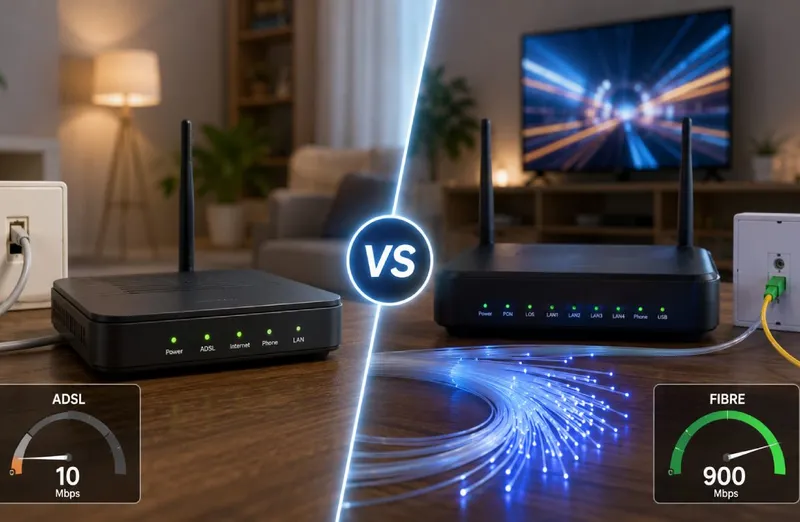
Fibre broadband beats ADSL on every measure that matters. ADSL tops out at 24 Mbps because it depends on ageing copper wire, while fibre, whether FTTC or FTTP, starts at 30 Mbps and climbs into the thousands on full fibre lines. Fibre also handles multiple devices, video calls and 4K streaming without buffering, because it carries far more bandwidth than copper. Switching to fibre cuts buffering and future-proofs a connection, if an address still runs on ADSL ahead of the 2027 copper switch-off.
How to Check Which Types of Broadband Are Available at Your Address
Enter a postcode into an online broadband checker to see which types of broadband internet reach a property, including ADSL, FTTC, FTTP, cable and 5G. Openreach and Ofcom both publish coverage checkers that show planned upgrade dates for areas still waiting on full fibre.
to see real prices and speeds side by side before choosing a provider.
Yes, most UK addresses can get superfast broadband (30 Mbps or higher) today, because FTTC alone covers 95% of premises and FTTP covers over 80%.
Broadband Alternatives If Fibre Isn't in Your Area
Satellite broadband, 5G home broadband and 4G routers work as broadband alternatives where fibre and cable have not been built yet.
Satellite broadband reaches remote rural properties that sit far from any exchange or cabinet, though it carries higher latency than fixed lines.
5G and 4G home broadband suit renters and anyone waiting for an FTTP installation date, since setup takes minutes and needs no engineer visit.
A subsidised connection through the government's Gigabit Broadband Voucher Scheme funds installation costs in areas Project Gigabit has not yet reached.
Anyone stuck on a slow connection while waiting for fibre can compare broadband, energy and mobile deals together on Switch to avoid overpaying on any one service while the upgrade is pending.
How Much Broadband Speed Do You Actually Need?
Most households need between 30 Mbps and 100 Mbps, depending on the number of devices connected at once and the type of activity running on each one.
Browsing, email and standard-definition video: 1 to 5 Mbps per device.
HD streaming on services such as Netflix or iPlayer: 5 to 8 Mbps per stream.
4K streaming: 25 Mbps per stream, since 4K video uses roughly 5 times the data of HD.
Online gaming: 3 to 6 Mbps per console, plus low latency under 30 milliseconds for competitive play.
Video calls for remote work: 3 to 4 Mbps upload per person, which matters more on ADSL and FTTC than on symmetrical FTTP lines.
A household of four running a 4K stream, a video call and two phones at the same time needs roughly 60 to 80 Mbps of combined bandwidth, which rules out ADSL and puts pressure on entry-level FTTC. Homes with several remote workers, smart home devices or a home server generally benefit from FTTP or cable, since both hold their advertised speed under heavier simultaneous use.
Which Type of Broadband Should You Choose?
The table below compares every broadband type on speed and typical use case.
Broadband Type | Download Speed | Best For |
ADSL | 8-24 Mbps | Addresses with no fibre option yet |
FTTC | 30-80 Mbps | Budget superfast broadband |
FTTP (full fibre) | 100-3,000 Mbps | Streaming, gaming and remote work |
Cable | 145-1,130 Mbps | Cities with Virgin Media coverage |
5G Home Broadband | 100-300 Mbps | Renters and quick, no-engineer setup |
Full fibre (FTTP) suits most households and small businesses today, since prices have fallen close to FTTC levels while speeds run 10 to 40 times higher. FTTC remains the sensible choice only where FTTP has not yet been built. Cable works as a strong alternative in Virgin Media areas, and 5G home broadband fills the gap for renters or anyone who needs a connection within days rather than weeks.
Final Thoughts
Five broadband types cover the UK in 2026: ADSL, FTTC, FTTP, cable and 5G home broadband, and full fibre now reaches most addresses at a competitive price. Check a postcode against a broadband checker, compare providers on speed and contract length, then switch before the January 2027 copper switch-off forces the decision.
Run a full broadband comparison on Switch to see every provider available at a specific address, alongside energy and mobile deals worth switching at the same time.
Frequently Asked Questions
What are the main types of broadband in the UK?
The UK has five main types of broadband: ADSL, FTTC, FTTP, cable and 5G home broadband. Each type uses different infrastructure and delivers different speeds, from 8 Mbps on ADSL to over 3,000 Mbps on full fibre.
Is FTTP better than FTTC?
Yes. FTTP delivers fibre straight to a property with no copper section, so it reaches speeds up to 3,000 Mbps compared with FTTC's 80 Mbps ceiling. FTTP also holds its speed regardless of distance from the exchange, while FTTC slows down the further a property sits from the street cabinet.
Does fibre broadband need a phone line?
No, not for FTTP. Voice calls run over the same fibre connection through a dedicated router, so a phone socket isn't required. FTTC still uses a phone socket for the final copper stretch, even though most customers now make calls over the internet instead of the traditional line.
What is the difference between full fibre and fibre broadband?
Full fibre (FTTP) runs fibre optic cable all the way into a property, while the term "fibre broadband" often refers to FTTC, which mixes fibre and copper. Full fibre reaches speeds up to 3,000 Mbps, and FTTC caps out around 80 Mbps because of its copper section.
Can I get superfast broadband where I live?
Yes, in most parts of the UK. FTTC covers 95% of premises and delivers superfast speeds of 30 Mbps or higher, and FTTP now reaches over 80% of addresses with even faster speeds. Enter a postcode into a broadband checker to confirm exact availability and speeds at a specific address.
What happens to ADSL and FTTC when the copper network switches off?
Openreach will switch off the copper PSTN network by January 2027, which ends ADSL and the copper portion of FTTC. Providers are migrating customers to FTTP or other fibre options ahead of the deadline, so anyone still on ADSL or FTTC should check upgrade options now.
Is 5G home broadband a good alternative to fixed-line broadband?
Yes, where 5G coverage is strong. 5G home broadband delivers 100 Mbps to 300 Mbps without cables or an installation appointment, which suits renters, short tenancies and homes waiting for a fibre connection date.