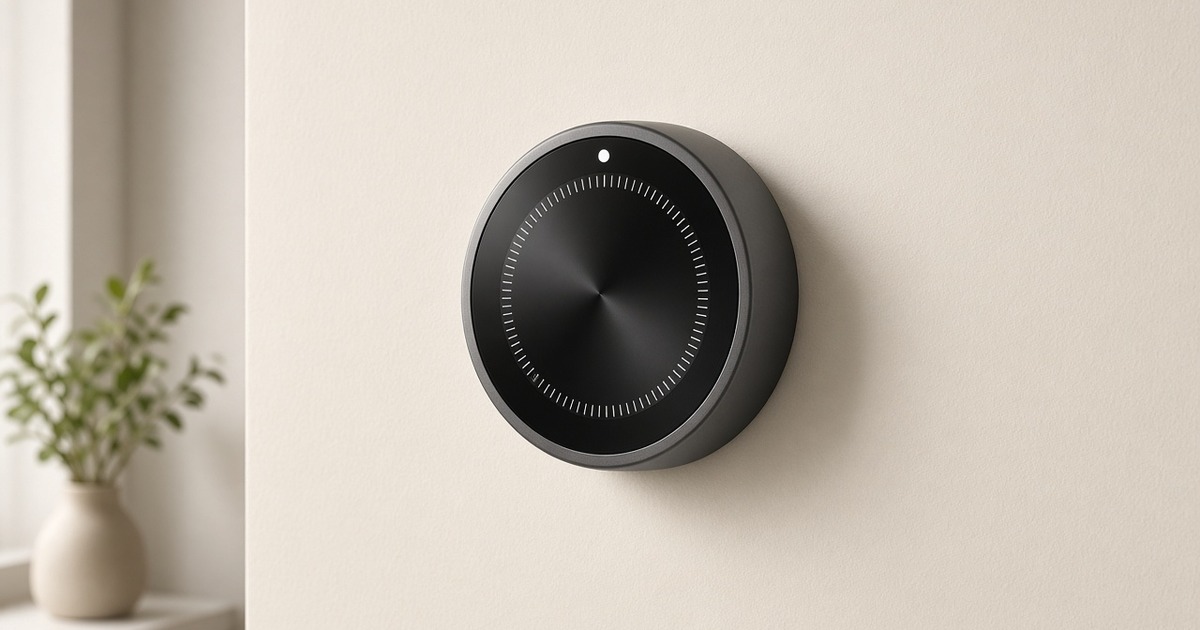
A smart thermostat is a Wi-Fi-connected heating control that lets you set, schedule, and monitor your home's temperature from a smartphone app instead of a wall dial. It replaces your existing room thermostat, connects to your boiler's wiring or a wireless receiver, and uses sensors, an app, and, on higher-end models, learning algorithms to heat your home only when needed. UK households typically cut gas use by 10% to 25% after fitting one, based on installer and industry data from 2026, and that saving comes without switching supplier or signing a new tariff.
What Is a Smart Thermostat?
A smart thermostat is a connected heating control device that replaces your traditional dial or digital display with app-based, remote, and often automatic temperature control. It sits on your wall or shelf in place of your old room thermostat, links to your boiler through a wired connection or a small wireless receiver, and pairs with an app on your phone. A standard programmable model only follows a fixed schedule. A Wi-Fi thermostat links to your home router instead, so you keep control after you leave the house, and it adjusts on its own based on your habits, the weather, or your location.
Compare home energy deals
- MoneySuperMarket residential gas & electricity journey
- Enter your postcode and usage for live quotes
- Household switch path only — not business energy
How Does a Smart Thermostat Work?
A smart thermostat combines temperature sensors, an internet connection, and a companion app to control your boiler automatically or on command.
Six components do the work:
Temperature sensors measure the air near the unit and, on multi-sensor kits, in individual rooms.
A Wi-Fi or hub connection sends your settings to the device and reports usage data back to the app.
A relay or wireless receiver switches your boiler's heating circuit on and off to hit your target temperature.
Learning software, on premium models, studies your manual adjustments over 1 to 2 weeks and automatically builds a schedule.
Geofencing tracks your phone's location and lowers the temperature once you leave a set radius, then raises it as you approach home.
Weather compensation adjusts the boiler's flow temperature against the outdoor temperature, so the system doesn't overwork on mild days.
Every connected thermostat handles sensing, connectivity, and boiler switching. Learning, geofencing, and weather compensation only appear on mid-range and premium units.
Types of Smart Heating Controls
Three main types cover most UK homes:
Single-zone Wi-Fi thermostats replace one room thermostat and control the whole home as one heating zone. They suit flats and smaller houses with a combi boiler.
Learning thermostats build a heating schedule from your manual changes and add geofencing, motion sensing, and detailed usage reports.
Multi-zone systems pair a home hub with smart thermostatic radiator valves (TRVs) on individual radiators, giving room-by-room control across a whole house.
If your home has more than one heating zone or a mix of well-used and rarely used rooms, a multi-zone kit pays back faster than a single sensor near the front door.
Which Type Suits Your Home?
Match the system to your property type rather than the highest-rated model on a review site, since a feature-heavy kit adds cost without adding savings in a small flat.
One-bed and two-bed flats: a single-zone Wi-Fi thermostat is usually enough, since one sensor covers the whole heated area accurately.
Three-bed and four-bed terraces or semis: a learning thermostat with 1 or 2 additional room sensors balances a warmer living room against a cooler landing.
Detached houses over 4 bedrooms: a multi-zone hub with smart TRVs on 4 to 8 radiators gives the biggest saving, since you stop heating spare rooms and hallways to the same target as your lounge.
Rented flats and houses: choose a battery-powered, wireless-receiver unit that clips onto the existing wiring, so you can take it with you and hand back an unmodified thermostat at the end of the tenancy.

Renters and Older UK Homes
Many pre-1990s UK properties wire their thermostat with only 2 wires and no permanent live (L) connection, which rules out mains-powered smart models that need a constant power feed. A wireless receiver kit gets around this: the thermostat itself runs on batteries and talks to a small receiver wired into the boiler, so no rewiring is needed. If you rent, check your tenancy agreement before altering any wiring, and favour a receiver-based kit you can uninstall in under 10 minutes when you move.
Combi Boiler Compatibility
Yes, a wireless thermostat works with a combi boiler in the large majority of UK homes, since combi systems make up most domestic boiler installs.
Compatibility depends on three things:
Wiring type. Older combi boilers with only two wires (no permanent live) need a battery-powered or wireless-receiver unit rather than a mains-wired model.
Boiler communication. OpenTherm-compatible boilers let a heating controller modulate the flame instead of switching it fully on or off, which improves efficiency and comfort.
Hot water control. A combi boiler heats water on demand, so most combi-compatible models only control heating. If you have a system boiler with a hot water cylinder, buy the HW (hot water) variant so you can schedule your cylinder too.
Check your current boiler's make and wiring before buying, since a controller built for a system boiler will not control a combi boiler's hot water in the same way.
Cost in the UK
A connected heating control typically costs £100 to £280 for the device, plus £50 to £100 for professional installation if you don't fit it yourself.
Item | Typical UK cost (2026) |
Single-zone Wi-Fi thermostat | £100 - £180 |
Learning thermostat with geofencing | £180 - £280 |
Multi-zone hub and starter kit | £195 - £470 |
Smart radiator valve (per radiator) | £50 - £70 |
Professional installation | £50 - £100 |
Compare home energy deals
- MoneySuperMarket residential gas & electricity journey
- Enter your postcode and usage for live quotes
- Household switch path only — not business energy
Multi-zone systems cost more upfront, but they let you heat 2 or 3 well-used rooms instead of the whole house, which often recovers the extra cost within a year.
None of the mainstream UK models charge an ongoing app subscription for core scheduling and remote control, though some premium energy-report or multi-home features sit behind a paid tier. Expect a device lifespan of 8 to 10 years and a standard manufacturer warranty of 1 to 2 years.
Will It Save You Money?
Yes, a connected heating control can save you money if you currently heat your home on a fixed schedule or forget to turn the heating down when you're out.
Savings depend on three factors: your current habits, your boiler's efficiency, and how much of the home you heat. Households that switch from a manual dial to scheduled, zoned, or geofenced heating typically save £100 to £500 a year, or 10% to 25% off the heating portion of their bill. The Ofgem price cap sits at £1,663 a year for a typical dual-fuel household on Direct Debit for the July to September 2026 quarter, so a 15% cut to the heating share of that bill is a meaningful saving. A connected thermostat doesn't lower your unit rate, though. For that, compare tariffs directly with Switch's energy comparison service, and check the current UK energy price cap guide to see what you should be paying before your next bill lands.
Best Features to Look For
Not every listed feature earns its price premium. Look for these 6 features when comparing connected heating models:
Matter or Thread support, so the device works across Apple Home, Google Home, and Amazon Alexa without a proprietary bridge.
OpenTherm compatibility, which lets the controller modulate your boiler's output instead of switching it fully on or off.
Geofencing with a manual override, since automatic location tracking should never lock out a manual adjustment.
Open-window detection, which pauses heating automatically when a sensor detects a sudden temperature drop.
A local backup schedule, so the device keeps running your last settings if your broadband connection drops.
An energy report inside the app, showing daily or weekly runtime so you can spot wasted heating.
Common Installation Mistakes to Avoid
Three mistakes account for most of the support calls installers report:
Fitting the unit above a radiator, near a window, or in direct sunlight, which feeds the sensor a false high reading and under-heats the rest of the home.
Skipping the OpenTherm setting during setup on a compatible boiler, which leaves the system running basic on/off control instead of the more efficient modulating mode.
Ignoring the app's firmware update prompt, since an outdated unit can lose Matter, Thread, or voice assistant support within a few months of release.
Installation: DIY or Professional?
You can install one yourself if you're replacing a like-for-like wired thermostat and you're comfortable working with low-voltage wiring.
Most single-zone models ship with clear wiring diagrams and take 30 to 60 minutes to fit. Book a professional installer instead when your boiler uses an unusual wiring setup, when you're adding OpenTherm or hot water control, or when your multi-zone kit needs a hub wired into the boiler itself. A professional installation typically costs £50 to £100 on top of the device price and usually comes with a workmanship guarantee.
Thermostat vs Meter: What's the Difference?
A heating controller and a smart meter are not the same device, and confusing the two is common.
A smart meter measures and reports how much gas and electricity you use; it sends automatic readings to your supplier and removes estimated billing. A heating controller manages how and when your heating runs; it doesn't report anything to your supplier and doesn't affect your billing accuracy. You can have one, both, or neither. Pairing a smart meter's usage data with a heating control's scheduling gives you the clearest possible picture of where your heating budget goes. For a full breakdown of the other device, read Switch's guide to how smart meters work.
Compare home energy deals
- MoneySuperMarket residential gas & electricity journey
- Enter your postcode and usage for live quotes
- Household switch path only — not business energy
Frequently Asked Questions
Is a smart thermostat worth it in the UK?
Yes, it's worth it for most UK households, if you currently heat your home on a fixed timer or forget to adjust it when you're out. Typical savings of £100 to £500 a year mean the device usually pays for itself within 12 to 24 months.
Do these devices work with combi boilers?
Yes, connected thermostats work with combi boilers, since combi systems make up most UK domestic installs. Check your existing wiring and, if you want flame modulation rather than simple on/off switching, look for OpenTherm support.
How much does installation cost?
Professional installation costs £50 to £100, on top of a device price of £100 to £280. DIY installation is free if you're comfortable working with low-voltage wiring and replacing a like-for-like thermostat.
Can I install one myself?
Yes, you can install a wireless thermostat yourself in most homes, if you're swapping a wired thermostat for another wired model with a matching setup. Multi-zone hubs and unusual wiring configurations are better left to a qualified installer.
Do they work without Wi-Fi?
Yes, a connected thermostat works without Wi-Fi for day-to-day heating, since the device keeps running its last saved schedule locally. You lose remote app control and voice assistant integration until your connection returns.
What's the difference between a heating controller and a smart meter?
A heating controller manages your temperature schedule. A smart meter measures your gas and electricity use and reports it to your supplier. They solve different problems and can be used together.
How much can it save on energy bills?
A well-set-up system can save £100 to £500 a year, or 10% to 25% of your heating costs, depending on your current habits and how much of your home you zone. Combine it with a competitive tariff for the biggest overall reduction, since scheduling alone won't offset a high unit rate.