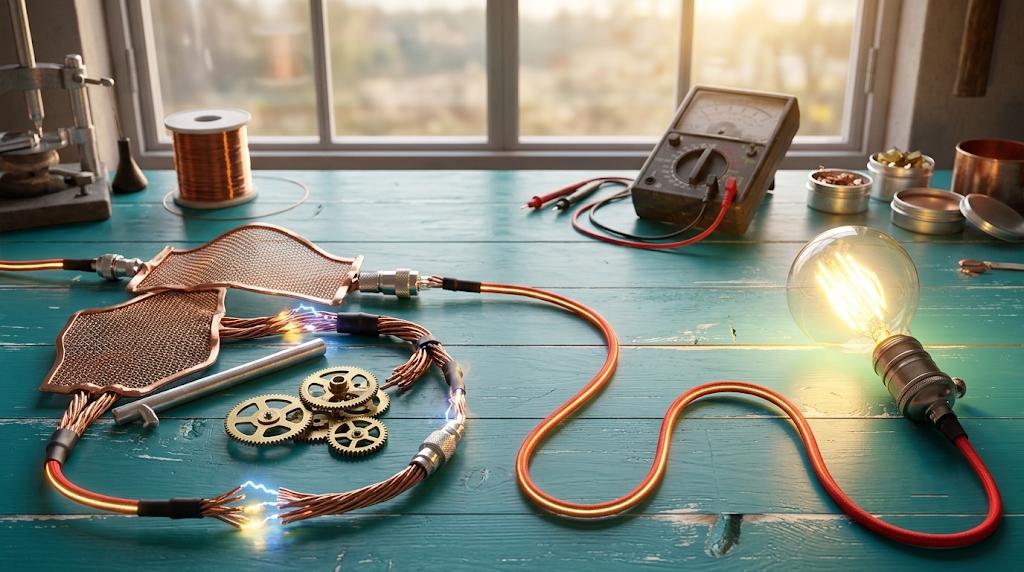
A conductor is a material that allows electricity to flow through it with minimal resistance. Without conductors, no electrical current could move from a power source to a device. Every wire in your home, every cable in the national grid, and every circuit in your appliances relies on a conductor to function. Understanding how conductors work helps explain why electricity reaches your sockets reliably and why the materials used matter so much.
What Is a Conductor?
A conductor is a substance through which electric current flows easily because its electrons can move freely between atoms. The key property of a conductor is low electrical resistance. The less resistance a material has, the better it conducts electricity.
Every material contains atoms with electrons arranged in two energy levels called the valence band and the conduction band. In a conductor, these two bands overlap. This means electrons in the outer shell of an atom need almost no extra energy to break free and move into the conduction band.
Once in the conduction band, electrons flow freely in response to an applied voltage, carrying electric current through the material. This is what makes a conductor work. In non-conducting materials called insulators, there is a large energy gap between the valence and conduction bands, so electrons cannot move freely.
What Is the Difference Between a Conductor and an Insulator?
A conductor allows electrons to flow freely. An insulator blocks that flow. Both are essential to electrical safety and function. Without an insulating material wrapping around conductive wires, touching a live cable would cause a fatal electric shock.
Property | Conductor | Insulator |
Electron movement | Free and easy | Restricted or blocked |
Electrical resistance | Very low | Very high |
Energy band gap | None (bands overlap) | Large gap between bands |
Common examples | Copper, silver, aluminium | Rubber, plastic, glass, ceramic |
Typical use | Wiring, cables, circuit boards | Cable sheathing, plugs, switches |
There is also a third category: semiconductors. Silicon and germanium sit between conductors and insulators. Their conductivity can be controlled, which is why they are used in transistors, solar panels, and microchips.
Why Are Conductors Important?
Conductors are important because they are the physical pathway through which electricity travels to power every device and system that uses electrical energy. Remove them, and electricity cannot move from its source to where it is needed.
There are 5 key reasons conductors are essential in everyday life:
Powering homes and businesses. Every plug socket, light fitting, and appliance connection uses a conductor, typically copper wiring, to carry current from the mains supply.
Transmitting electricity across the national grid. High-voltage transmission lines use aluminium-core steel-reinforced (ACSR) conductors to carry electricity from power stations across the country.
Enabling telecommunications. Telephone lines, broadband copper cables, and fibre-optic networks all depend on conductive materials to transmit data signals reliably.
Supporting medical technology. MRI machines, heart monitors, and surgical equipment all rely on precisely specified conductive materials for accurate and safe operation.
Making renewable energy viable. Solar panels use conductive metal contacts to collect generated electricity. Wind turbines use copper windings in their generators to convert mechanical energy into electrical current.
Why Are Metals Good Conductors of Electricity?
Metals are good conductors because their atomic structure allows electrons to move freely. In a metal, the outermost electrons are only loosely bound to their parent atoms. These electrons, called free electrons or delocalised electrons, can drift through the metal lattice with very little energy applied.
When a voltage is applied across a metal, it creates an electric field. This field pushes the free electrons in one direction, producing a current. The more free electrons a metal has, and the easier they can move, the better the conductor it is.
Temperature affects this. At higher temperatures, metal atoms vibrate more, which increases resistance by making it harder for electrons to move through the lattice without collision. This is why most metals conduct electricity better at lower temperatures. Superconductors take this to its extreme: at temperatures close to absolute zero (−273.15°C), certain materials lose all electrical resistance.
Which Metals Are the Best Conductors of Electricity?
Not all metals conduct electricity equally. Conductivity is measured in siemens per metre (S/m). Here are the 5 best electrical conductors and how they compare:
Metal | Conductivity (S/m approx.) | Common Use | Drawback |
Silver | 6.3 × 10⁷ | Switches, LEDs, satellites, specialist circuits | High cost, tarnishes over time |
Copper | 5.96 × 10⁷ | Household wiring, motors, transformers, PCBs | Relatively expensive |
Gold | 4.52 × 10⁷ | Circuit board contacts, aerospace connectors | Very high cost |
Aluminium | 3.5 × 10⁷ | Power grid transmission lines, large-scale wiring | Prone to oxide film build-up |
Iron/Steel | 1.0 × 10⁷ | Structural components, reinforced cables | Lower conductivity than copper |
Silver
Silver is the best conductor of electricity of any element, with a conductivity of around 6.3 × 10⁷ S/m. It has 47 electrons, and its single outer shell electron moves with very little resistance. Its high cost limits widespread use, but silver is found in light switches, television LED components, satellite electronics, and specialist high-frequency circuits where maximum conductivity is essential.
Copper
Copper is the most widely used conductor in the UK and globally. With 29 electrons and a conductivity of around 5.96 × 10⁷ S/m, copper wiring is standard in domestic and commercial electrical installations. Its good balance of conductivity, corrosion resistance, and flexibility makes it ideal for everything from household ring mains to motor windings and printed circuit boards (PCBs).
Gold
Gold has a conductivity of around 4.52 × 10⁷ S/m and, unlike silver, does not tarnish. This makes it valuable for connector contacts and edge connectors on circuit boards, where a stable, reliable contact surface is critical. It is commonly used in aerospace electronics, high-reliability connectors, and SIM cards.
Aluminium
Aluminium conducts at roughly 60% the rate of copper by volume, but it is significantly lighter and cheaper. This makes it the preferred choice for overhead power transmission lines on the national grid, where cable weight is a major engineering consideration. Its drawback is that its surface can oxidise, forming aluminium oxide a poor conductor which can reduce long-term performance in some applications.
Iron and Steel
Iron and steel are poor conductors compared to copper and silver, but they are used where mechanical strength matters more than conductivity. Steel cores in aluminium conductor steel-reinforced (ACSR) cables provide structural support, while the aluminium carries the current. Iron is also found in transformer cores, where its magnetic rather than conductive properties are exploited.
Surprising Materials That Conduct Electricity
Metals are the primary conductors, but 4 other materials can also conduct electricity under the right conditions:
Seawater. Seawater contains dissolved sodium and chloride ions. These charged particles, not electrons, carry the current. This is called ionic conduction. Pure distilled water does not conduct electricity, but seawater does, which is why contact with saltwater and live electricity is extremely dangerous.
The human body. The human body is a conductor due to the presence of electrolyte ions, including sodium, potassium, and chloride, in the blood and tissues. This is why electric shocks are dangerous. The body provides sufficient conductivity for current to pass through it, leading to muscle spasms, burns, or cardiac arrest.
Graphite (carbon). Most non-metals are insulators, but graphite is an exception. Its layered structure allows electrons to move between layers, giving it measurable conductivity. It is used in electrodes and battery terminals.
Plasma. At extremely high temperatures, gases become ionised, forming plasma, a state of matter with very high conductivity. Lightning is a natural example of electrical discharge through plasma.
How Conductor Quality Affects Your Electricity Use
Poor conductors waste energy as heat. When electricity passes through a material with high resistance, some of the electrical energy is converted into heat rather than reaching the intended device. This is called resistive heating or Joule heating.
In a domestic setting, this matters in 3 specific ways:
Old or damaged wiring. Corroded, undersized, or poorly jointed copper wiring increases resistance. This can cause wires to overheat, increasing the risk of fire and reducing the efficiency of circuits supplying appliances.
Extension lead quality. Cheap extension leads use thinner conductors with higher resistance. Running high-wattage appliances like electric heaters or washing machines through a poor-quality extension lead wastes energy and generates dangerous heat.
National grid transmission losses. Electricity loses roughly 1.7–2% of its energy during transmission and distribution across the UK grid each year due to resistive losses in cables. High-voltage transmission reduces current (and therefore resistive loss) over long distances, which is why the grid runs at 132,000V to 400,000V rather than the 230V used in homes.
Frequently Asked Questions About Electrical Conductors
What is the simplest definition of a conductor?
A conductor is any material that allows electric current to flow through it easily. This happens because the material has loosely bound electrons that can move freely between atoms when a voltage is applied. Copper wire inside a plug lead is a straightforward example.
What are the 3 main types of electrical conductors?
The 3 main categories are conductors, semiconductors, and superconductors. Conductors (copper, silver) allow current to flow with low resistance. Semiconductors (silicon, germanium) have controllable conductivity and are used in electronics. Superconductors lose all resistance below a critical temperature, typically near absolute zero, and are used in MRI machines and research applications.
Why is copper used for electrical wiring instead of silver?
Copper is used instead of silver because it offers a near-equivalent conductivity at a fraction of the cost. Silver is the better conductor, but at around 80 times the price of copper per kilogram, it is not practical for the kilometres of wiring needed in homes, commercial buildings, or the national grid. Copper also has good flexibility, corrosion resistance, and is easy to solder.
Is water a conductor of electricity?
Pure distilled water is not a conductor. However, water containing dissolved minerals, salts, or impurities, including tap water and seawater, does conduct electricity because it contains ions that carry an electric charge. This is why contact with water near live electrical circuits is dangerous. Never use water to extinguish an electrical fire.
What makes a material a poor conductor (insulator)?
A material is a poor conductor when there is a large energy gap between its valence and conduction bands, preventing electrons from moving freely. Rubber, plastic, glass, and dry wood are common insulators. These materials are used to coat electrical wires and make plug casings, protecting users from direct contact with live conductors.
Does temperature affect how well a conductor works?
Yes most conductors become less efficient at higher temperatures. As the temperature rises, atoms in a metal vibrate more rapidly, creating more obstacles for moving electrons. This increases resistance and reduces conductivity. Aluminium wiring is particularly affected by surface oxidation at high temperatures, which can form aluminium oxide, which significantly impairs conductivity over time.
How do conductors relate to my home electricity supply?
Every part of your home's electricity supply depends on conductors. Copper wiring runs from your meter through your consumer unit and out to every socket, switch, and fitting. The cables connecting your street to the local substation are made of aluminium or copper. The national grid uses aluminium-core steel-reinforced (ACSR) cables to carry high-voltage electricity from power stations. The quality and condition of these conductors directly affect the reliability and safety of your supply.



.jpg)