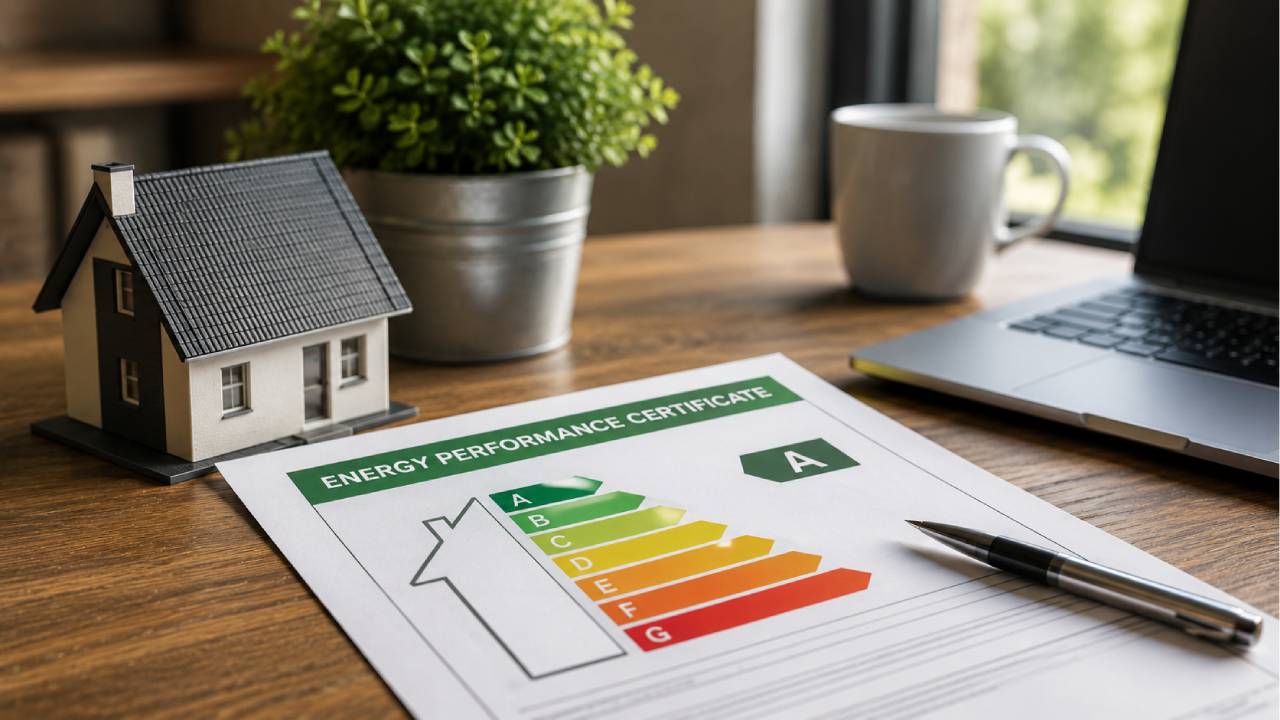
An EPC (Energy Performance Certificate) is a legal document that rates a property's energy efficiency on a scale from A to G, with A the most efficient. Every home or business that's sold, rented, or newly built in the UK needs a valid EPC before it goes on the market. The certificate lists current running costs, a potential efficiency score after improvements, and the property's estimated carbon emissions. In 2026, an EPC matters more than most homeowners realise, since landlords face tightening Minimum Energy Efficiency Standards and energy bills remain among the highest costs UK households incur.
What Is an EPC (Energy Performance Certificate)?
An EPC records how energy efficient a building is and estimates what it costs to heat, light, and run over a year. It's produced using the Reduced Standard Assessment Procedure (RdSAP) for existing homes, or the full Standard Assessment Procedure (SAP) for new builds. An accredited Domestic Energy Assessor (DEA) issues the certificate after visiting the property, and the completed EPC certificate is uploaded to the national EPC register, where it stays valid for 10 years.
Beyond the headline rating, an energy performance certificate also shows the property's potential score if recommended upgrades are carried out, a breakdown of energy use by feature (walls, roof, windows, heating), and the estimated annual cost for heating, hot water, and lighting. It does not cover appliance running costs such as washing machines or ovens, and it doesn't account for how many people actually live in the property, since scores are based on standard occupancy assumptions.
How to Check an EPC by Postcode (Free EPC Checker)
Search the property's postcode on the official EPC register to check an EPC for free. No login or payment is needed to look up an existing certificate.
In England, Wales, or Northern Ireland: use the gov.uk EPC register and enter the property's postcode or the certificate's report reference number.
In Scotland, use the Scottish EPC Register, as it operates a separate domestic register.
If the property has never had an assessment, no record will show. In that case, the property needs a new EPC before it can be marketed for sale or rent.
This kind of EPC certificate check is the fastest way to find an EPC without contacting an assessor directly. It also lets buyers and tenants compare a property's rating against similar homes nearby before making an offer or signing a tenancy. If someone is comparing running costs across properties, it's worth pairing an EPC lookup with a proper home energy comparison, since a good EPC rating doesn't guarantee a cheap tariff.
EPC Ratings Explained (A to G)
An EPC rating runs from A, the most efficient, down to G, the least efficient, based on a numerical score out of 100. The average EPC rating for homes in England and Wales currently sits at Band D, with an average score of 60.
EPC Rating | Score Range | Efficiency Level |
A | 92 - 100 | Most efficient |
B | 81 - 91 | Very efficient |
C | 69 - 80 | Efficient |
D | 55 - 68 | Average (UK average rating) |
E | 39 - 54 | Below average |
F | 21 - 38 | Poor |
G | 1 - 20 | Least efficient |
A higher score means lower running costs and lower estimated carbon emissions. Properties built after 2012 tend to average a B rating, while homes built before 1919 average an E, mainly due to solid walls and limited loft insulation.
EPC Certificate Cost: How Much Does an EPC Cost?
An EPC certificate typically costs between £60 and £120. The exact cost of an energy performance certificate depends on the property's size, location, and the urgency of the assessment. Larger properties and non-domestic buildings usually sit at the top of that range, since they take longer to survey.
Booking directly with an accredited assessor, rather than through an estate agent, usually reduces the cost. Anyone comparing quotes should confirm the assessor's accreditation number against the Landmark EPC register before booking, since only accredited assessors can issue a valid certificate.
How Long Does an EPC Last?
An EPC certificate is valid for 10 years from its issue date. There's no legal requirement to renew it during that period unless the property is sold, re-let to new tenants, or substantially altered. If energy-saving improvements are made partway through the 10 years, the rating won't update automatically. A new assessment has to be booked to reflect those changes on the register.
Who Needs an EPC?
Selling a property
The seller must commission a valid EPC before marketing the property. It has to be made available to potential buyers from the point the property is first listed.
Renting a property
The landlord is responsible for providing a valid EPC to tenants before a tenancy starts. Tenants aren't required to order one themselves, but they can request a copy from the landlord or letting agent at any point.
Landlords and Minimum Energy Efficiency Standards (MEES)
Since April 2020, privately rented homes in England and Wales must meet a minimum EPC rating of E unless a registered exemption applies. Properties rated F or G currently can't be legally let. The government has proposed raising this threshold further, requiring new tenancies to reach EPC C from 2028 and all tenancies to meet EPC C by 2030, though these dates remain subject to confirmation.

How to Get an EPC Certificate
Book an accredited Domestic Energy Assessor to survey the property. The steps are straightforward:
Find an accredited assessor through the government's EPC register or a local energy assessment company.
The assessor visits the property, which usually takes 45 to 90 minutes depending on the property's size, and records details about insulation, glazing, heating, and lighting.
The assessor submits the data, and the certificate appears on the national register, usually within a few days.
An EPC can't be issued without a physical visit, so it isn't possible to get one purely online. What's available online is the lookup service, not the inspection itself.
How to Improve an EPC Rating
The table below shows common upgrades and their typical effect on a property's score. Costs and point gains vary by property, but this gives a realistic starting point.
Improvement | Typical Cost | Possible Score Boost |
Top up loft insulation to 270mm | £350 - £900 | 10 - 15 points |
Cavity wall insulation | £1,000 - £2,500 | 5 - 10 points |
Insulate the hot water cylinder | £20 - £35 | 1.5 - 2 points |
Replace an old boiler with an A-rated condensing boiler | £2,000 - £4,000 | 4 - 23 points |
Install double glazing | £4,000 - £9,000 | 5 - 10 points |
Insulation upgrades usually deliver the biggest score improvement for the lowest spend, which is why most EPC recommendation lists put them first. Anyone budgeting for these improvements while reviewing household bills can compare dual-fuel energy deals or green energy tariffs alongside the upgrade work, since a better rating and a better tariff both reduce the same bill.
EPC Exemptions: Which Buildings Don't Need One
Most buildings need an EPC, but some are exempt from the requirement:
Listed buildings, where meeting minimum standards would alter their character
Places of worship
Buildings scheduled for demolition
Temporary buildings used for two years or less
Stand-alone buildings under 50 square metres of floor space
Holiday accommodation rented out for less than four months a year
An exemption still needs to be registered with the local authority. It isn't automatic just because a property fits one of these categories.
Frequently Asked Questions
What is an EPC certificate?
An EPC certificate is a legal document that rates a building's energy efficiency on a scale of A to G. It's required whenever a UK property is sold, rented, or newly built, and it remains valid for 10 years.
How do I find my EPC by postcode?
Enter the property's postcode into the gov.uk EPC register for homes in England, Wales, and Northern Ireland, or the Scottish EPC Register for Scottish properties. The search is free and returns the current certificate if one exists.
How much does an EPC cost?
An EPC costs between £60 and £120 on average. Larger properties and commercial buildings usually cost more due to longer assessment times.
How long does an EPC last?
An EPC lasts 10 years from its issue date, regardless of how many times the property changes hands during that period.
Do I need an EPC to rent out my property?
Yes. Landlords must provide tenants with a valid EPC before a tenancy begins, and the property must meet a minimum E rating unless a registered exemption applies.
Can I get an EPC certificate online?
No. An assessor has to visit the property in person to issue a valid EPC. Existing certificates, however, can be looked up online for free through the EPC register.
What happens if I don't have a valid EPC?
Selling or renting a property without a valid EPC can result in a fine of up to £5,000 per property. Trading Standards handles enforcement, and buyers or tenants can report a missing EPC directly.
Checking a property's EPC is one part of managing household running costs. Once the rating is confirmed, comparing home electricity deals or broader energy guides on Switch helps turn a good EPC rating into a real reduction in the monthly bill.

.jpg)