This moving house energy guide covers 3 steps: tell your current supplier you are moving, take meter readings on move day, then switch away from the deemed contract at your new address instead of accepting it. Ofgem's price cap sits at £1,862 a year for a typical dual-fuel household from July 2026, and a deemed contract can run £200 to £300 higher than a fixed tariff. Follow this moving house energy guide to avoid paying for someone else's usage or sitting on the most expensive tariff on the market, and use the checklist, cost breakdown, and 8 FAQs below to handle both the old and new address correctly.
How to Tell Your Energy Supplier You Are Moving House
To tell your supplier you are moving house, call them or use their online move service at least 48 hours before you leave, though you can give up to 28 days' notice. Give your move-out date, forwarding address, and final meter readings so the supplier closes your account correctly. Skip this step and the account stays open in your name, and the bills keep arriving after you have left.
Contact your supplier by phone, app, or online form.
State your exact move-out date.
Provide your forwarding address for the final bill.
Submit accurate meter readings on the day you leave.
What Happens to Gas and Electricity When You Move Out
Your final bill arrives within 6 weeks of your move-out date under Ofgem rules. The supplier calculates the final bill from the closing readings you provide, not an estimate. The refund follows automatically if you are in credit, and you should clear the balance before the final demand becomes overdue if you owe money instead.
Setting Up Energy at Your New Address
To set up energy at a new address, take opening meter readings the day you collect the keys and find out which supplier currently serves the property. A deemed contract with the outgoing supplier starts automatically the moment you move in, and deemed contracts run on the Standard Variable Tariff (SVT), the most expensive rate a supplier offers.
A Meter Point Administration Number (MPAN) identifies an electricity supply, and a Meter Point Reference Number (MPRN) identifies a gas supply. Find both numbers on a recent bill, or ask the new supplier to look them up from the property address.
New Builds and Independent Gas Transporter (IGT) Networks
Check the MPRN prefix first if the property is a new build. A prefix of 74 or 75 means an Independent Gas Transporter (IGT), not the National Grid, owns the pipes on that street, and IGT-connected homes often carry higher standing charges and fewer supplier choices. This detail gets left out of most moving guides, and it explains why 2 identical-looking new-build streets can have different gas costs.
Smart Meters After a Move
A smart meter at a new address needs re-pairing with the new occupier's account before the in-home display (IHD) works again. Re-pairing usually completes within a few weeks of registering the account, and the meter still records usage correctly in the background even while the display sits blank. Contact the supplier directly if the display has not connected after 4 weeks instead of assuming it needs a replacement.
Switching Energy Suppliers When Moving House
You can switch energy suppliers when moving house from day one, since deemed contracts carry no exit fees. Compare fixed tariffs against the £1,862 price cap and switch within your first 2 weeks to stop the deemed rate from adding up. This moving house energy guide recommends locking in a fixed deal before the first bill lands rather than waiting to see what arrives.
Some suppliers carry a fixed tariff to a new address, and others close the account and open a new one instead. Ask the current supplier before moving day whether the fixed rate transfers, since the policy differs by company.

Average Electricity Bill for a 2 Person Household After Moving House Energy
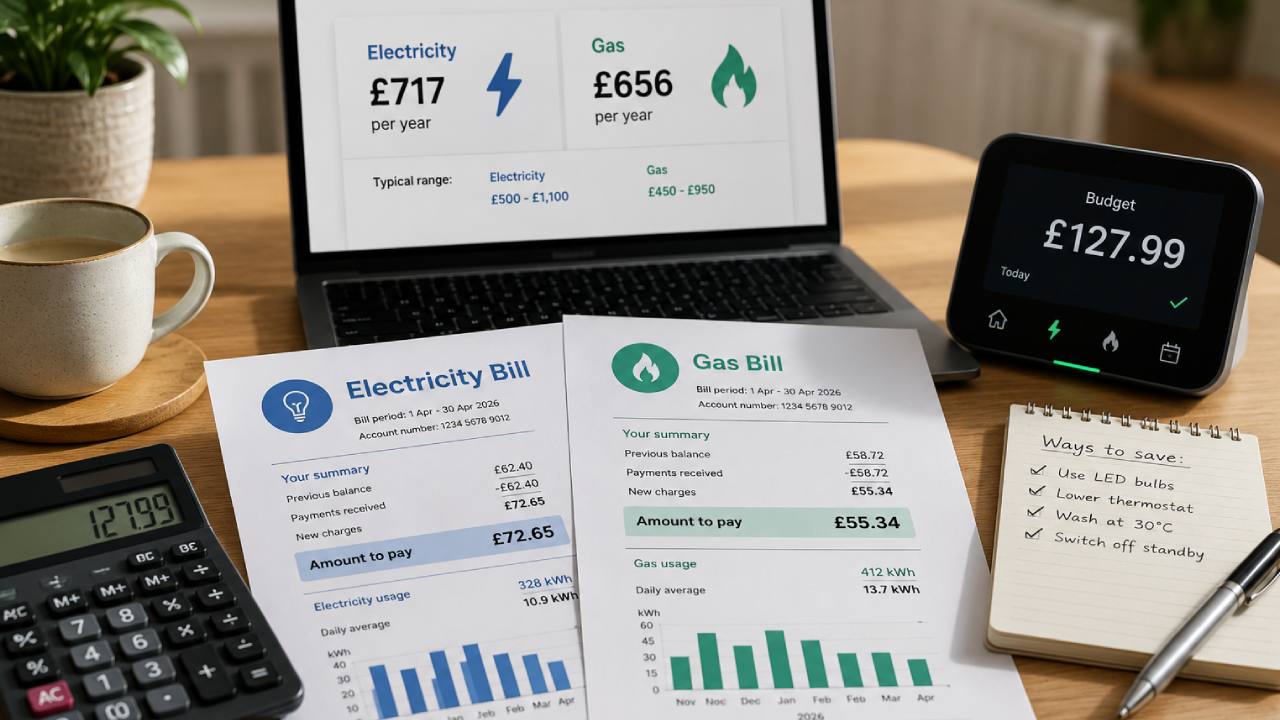
The average electricity bill for a 2-person household in the UK is about £800 a year, or £67 a month, for a gas-heated home in 2026. This figure uses 2,400 kWh of yearly consumption plus the Ofgem standing charge of 57.21p a day, which adds roughly £209 a year before any usage. A kilowatt-hour (kWh) is the energy a 1,000-watt appliance uses running for 1 hour, and it is the unit every supplier bills against.
Add gas heating and the combined dual-fuel bill for the same household moves toward £1,862 a year, the Ofgem price cap for July to September 2026. A low-use 2 person household pays closer to £59 a month on electricity, and a higher-use household pays around £73 a month instead.
Moving House Utilities Checklist: Before, During, and After
A moving house utilities checklist splits into 3 stages, and each stage carries its own deadline. Handle gas, electricity, water, and broadband on the same timeline instead of treating them as separate tasks, since most of the paperwork overlaps.
Before the move (7 to 28 days out):
Notify the current gas and electricity supplier of the move-out date.
Book the broadband transfer or cancellation with the provider.
Confirm whether the new property already has an active supplier.
Set a reminder for meter readings on the last day.
Moving day:
Photograph the gas and electricity meters at the old address.
Photograph the gas and electricity meters at the new address.
Submit both sets of readings to the relevant suppliers within 24 hours.
After the move (weeks 1 to 3):
Check the deemed contract rate against the current price cap.
Switch to a fixed tariff if the deemed rate costs more.
Update the address on the electoral roll and with the DVLA.
Confirm the final bill from the old address arrives within 6 weeks.
Transfer Electric Service to a New Address: Step by Step
To transfer electric service to a new address, contact the incoming supplier with the property address and the move-in date, then supply the opening meter reading once you have the keys. Most suppliers activate the account within 24 hours of that call, and the deemed contract runs until the switch to a chosen tariff completes.
New house electricity setup differs slightly for a new build, since the property may never have carried an account before. Order a new connection through the regional Distribution Network Operator (DNO) if the plot has no existing supply, and expect a lead time of 2 to 6 weeks for a standard domestic connection.
Energy Considerations When Relocating to a Different Region
Energy considerations when relocating include regional standing-charge differences, since the price cap sets a national unit rate but standing charges vary by distribution area. North Wales and Merseyside carry some of the highest standing charges in Great Britain, while London tends to sit lower, so a move between regions can shift the bill even at identical usage. Check the standing charge for the new region before assuming last year's bill will repeat itself, since a 100-mile move can change the daily fixed cost by several pence.
Changing energy provider during a move works best inside the first 2 weeks, before the deemed rate has run for a full billing cycle. Ask a prospective supplier whether it offers a direct energy move service that transfers gas and electricity together in a single call, since that removes 1 of the 2 separate switch requests most movers have to make.
Moving Home Energy Supplier: Common Mistakes That Cost You Money
5 mistakes drain money from movers every year, and each one is avoidable with a single phone call or a same-day meter reading.
Staying on the deemed contract for months instead of switching in week 1.
Forgetting to submit meter readings on move day.
Assuming the previous occupant's supplier is still the cheapest option.
Ignoring the MPRN prefix on a new-build property.
Delaying contact with the supplier past the 48-hour notice window.
What If the Final Bill Looks Wrong?
Query a final bill within 28 days if the figure does not match your own readings, and keep the photographed meter readings as proof. Suppliers must correct a billing error under Ofgem rules once you provide evidence, and an unresolved dispute can go to the Energy Ombudsman after 8 weeks with no fix. Escalate in writing rather than by phone alone, since a written complaint creates the paper trail the Ombudsman needs to review the case.
Frequently Asked Questions
Can I have electricity in two houses while moving?
Yes. You can hold live electricity accounts at both an old and new address during a move, since each supplier bills its own property from its own meter readings. Overlap of a few days is normal, and closing the old account promptly stops double charges.
How much notice do I need to give my energy supplier before moving house?
48 hours is the minimum notice UK suppliers require, and you can notify them up to 28 days in advance instead.
What happens if I don't take meter readings when I move house?
Your final bill defaults to an estimate if you skip meter readings, and estimates usually come in higher than actual usage. Submit readings on move-out day and move-in day to avoid disputing an inflated bill later.
Do I have to accept the deemed contract at my new address?
No. A deemed contract activates automatically on move-in day, but you can switch away from it immediately, since it carries no exit fees.
How do I find out who supplies gas and electricity at my new address?
Call the regional electricity distribution operator for the wires, and call the Meter Number Helpline on 0870 608 1524 for the gas network operator. Both calls are free, and both operators confirm the current retail supplier's name.
What is an MPAN and MPRN, and where do I find mine?
An MPAN (Meter Point Administration Number) identifies an electricity supply, and an MPRN (Meter Point Reference Number) identifies a gas supply. Find both numbers on a recent energy bill, or ask the new supplier to look them up using the property address.
Will moving house affect my credit score?
No. A standard house move and energy switch does not affect your credit score, since suppliers run a soft search that other lenders cannot see. An unpaid final bill sent to debt collection can affect your score, though, if it goes unresolved.
Do I need to sort broadband too when I move house?
Yes. Broadband sits outside the gas and electricity switch entirely, and moving house utilities as a group means contacting the broadband provider separately about transferring or cancelling the contract. Give the broadband provider the same notice period as the energy supplier, since some contracts carry an early-exit fee that a home move can waive.
Compare and Switch Before Moving Day
This moving house energy guide saves the most money when you act before the deemed rate compounds. Compare gas and electricity deals with Switch and lock in a fixed tariff before your first bill at the new address arrives.
Switch's gas and electricity comparison tool covers postcode-level pricing for every UK region beyond the national averages in this guide.
-1.jpg)