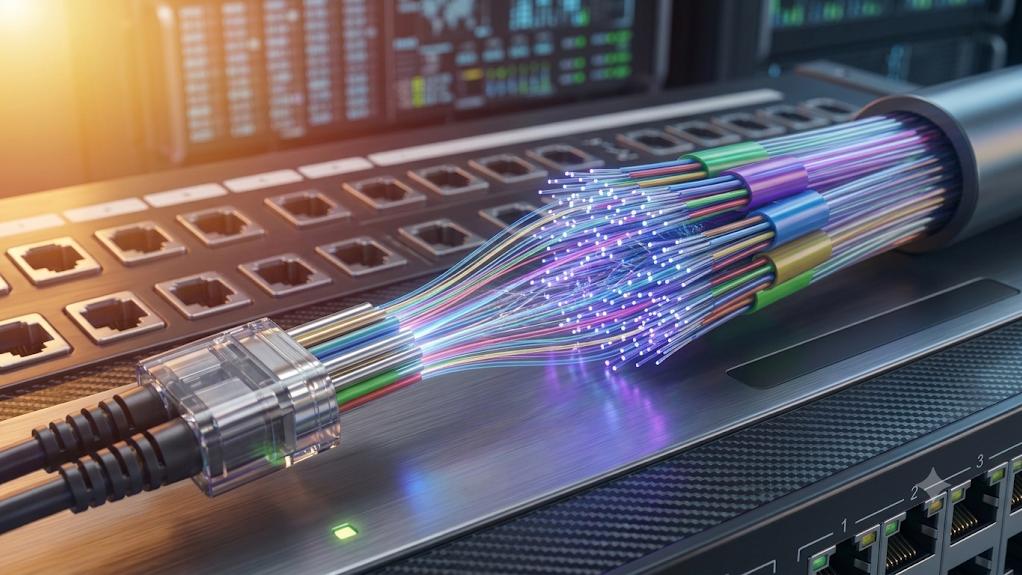
Full fibre broadband uses fibre-optic cables from your provider all the way into your home with no copper wire involved at any point. Also called fibre to the premises (FTTP), full fibre broadband delivers download speeds from 100 Mbps up to 1 Gbps or more, making it the fastest type of home internet connection available in the UK today. Unlike standard fibre, where copper wires handle the final stretch to your door, full fibre removes that bottleneck entirely, giving you a faster, more consistent connection.
What Does Full Fibre Broadband Mean?
Most UK homes currently use part-fibre broadband, also known as fibre to the cabinet (FTTC). With FTTC, fibre-optic cables run from the exchange to a green street cabinet near your home. Older copper phone wires then carry the signal the rest of the way to your door. The longer that copper stretch, the weaker and slower your connection becomes.
Full fibre or FTTP removes copper from the equation entirely. Fibre-optic cables run directly from the exchange all the way into your home. The result is symmetrical or near-symmetrical speeds, lower latency, and a connection that doesn't degrade based on how far you live from the street cabinet.
At a glance:
Part fibre (FTTC): fibre to the cabinet, copper wire to your home, typical speeds 30–70 Mbps
Full fibre (FTTP): fibre all the way to your premises, speeds from 100 Mbps to 1 Gbps+
Ultrafast full fibre: some providers now offer 2,000+ Mbps (2.3 Gbps) on FTTP networks
How Does Full Fibre Broadband Work?
Full fibre works by transmitting data as pulses of light through thin glass or plastic strands. These fibre-optic cables carry far more data than copper wires and experience almost no signal loss over distance. When the light signal reaches your home, a device called an Optical Network Terminal (ONT) converts it into an electrical signal your router can use to distribute Wi-Fi to your devices.
Because data travels at the speed of light and copper plays no part in the journey, full fibre is not affected by distance from a street cabinet, electrical interference, weather, or the physical degradation that copper wires experience over time.
Difference Between Fibre and Full Fibre Broadband
The key difference between fibre and full fibre broadband is how much of your connection uses fibre-optic cable. Standard fibre (FTTC) uses fibre for the main network but switches to copper wire for the last few hundred metres to your property. Full fibre (FTTP) uses fibre end to end.
This distinction matters because copper degrades. Speed drops the further you are from the cabinet. With full fibre, your speed is consistent whether you live 50 metres or 500 metres from the exchange. Upload speeds also improve significantly FTTC typically offers 10–20 Mbps upload, while FTTP can deliver symmetrical speeds where upload matches download.
6 Benefits of Full Fibre Broadband
Switching to full fibre gives you 6 practical advantages over standard fibre and ADSL connections:
Faster speeds: download speeds from 100 Mbps up to 1 Gbps or more, compared to 30–70 Mbps on FTTC
Better upload speeds: uploading large files, video calling, and live streaming become significantly faster
Lower latency: response times drop to under 5ms on full fibre, compared to 20–30ms on copper-based connections critical for gaming and video calls
More reliable: no signal degradation from weather, electrical interference, or physical wear on copper cables
Handles multiple devices: full fibre handles 10, 15, 20+ connected devices simultaneously without bandwidth contention
Future-proof: FTTP infrastructure supports gigabit and multi-gigabit speeds without replacing the cable into your home
Is Full Fibre Broadband Worth It?
Yes full fibre is worth it for most UK households. Full fibre broadband costs roughly the same as standard fibre deals, with many providers offering packages from £25–£40/month for 150–500 Mbps. At that price point, the speed and reliability gains are substantial.
Where full fibre makes the most difference is in homes with 4 or more people online at the same time, households with remote workers or video call users, properties with smart TVs, gaming consoles, smart home devices, and security cameras all running simultaneously, and anyone currently receiving speeds below 30 Mbps on a slow FTTC or ADSL line.
If you only use one device and browse casually, standard fibre may suffice but as device counts grow and streaming quality increases to 4K and 8K, full fibre becomes the more sensible long-term choice.
Can I Get Full Fibre Broadband in My Area?
Yes, full fibre broadband is available to around 70% of UK premises as of 2025, with the government targeting full coverage by 2030 through Project Gigabit. Coverage varies significantly by region major cities and many suburban areas are already well-served, while some rural postcodes are still awaiting FTTP rollout.
To check if full fibre is available at your address, enter your postcode on a comparison site. Switch lets you check and compare full fibre broadband deals in seconds compare full fibre broadband deals here.
Which Providers Offer Full Fibre Broadband in the UK?
7 major providers now offer full fibre broadband deals across the UK:
BT full fibre (Openreach network): available in most UK towns and cities via BT's FTTP rollout
Sky: full fibre packages on the Openreach network
Vodafone: FTTP deals on both Openreach and CityFibre networks
Virgin Media: operates its own hybrid-fibre cable network with FTTP available in select areas
Hyperoptic: pure full fibre specialist in UK cities offering up to 1 Gbps symmetrical speeds
TalkTalk: FTTP packages on Openreach and its own network
Smaller altnets: regional providers including Gigaclear, Community Fibre, and Zzoomm building FTTP in specific areas
FTTP Rollout: When Will Full Fibre Reach My Area?
The UK FTTP rollout is ongoing. Openreach BT's network infrastructure arm has committed to passing 25 million premises with full fibre by the end of 2026. CityFibre is building its own network in 60+ UK cities. The government's Project Gigabit subsidises deployment in hard-to-reach rural areas.
If full fibre is not yet available in your area, compare the fastest broadband deals currently available at your postcode to make the most of what's there now, and set a reminder to check again in 3–6 months as rollout continues.
How to Get Full Fibre Broadband
To get full fibre broadband, follow these 4 steps:
Check availability: enter your postcode on Switch to see which full fibre deals are available at your address
Choose a package: pick the right speed tier 100–150 Mbps suits light households, 500 Mbps–1 Gbps suits heavy users or large families
Book installation: a full fibre installation engineer will visit to connect the fibre cable to your property and fit an ONT this typically takes 2–4 hours
Connect your router: your provider's router plugs into the ONT and your home Wi-Fi is live
Most providers use the Openreach One Touch Switching process, meaning you don't need to cancel your old contract yourself your new provider handles the transfer. Switching typically takes 10–14 working days.
Full Fibre vs Superfast Broadband: What's the Difference?
Superfast broadband is defined as any connection delivering 30 Mbps or more this includes FTTC connections. Ultrafast broadband refers to speeds of 100 Mbps and above, which full fibre delivers as standard. Full fibre is therefore always ultrafast, but not all ultrafast broadband is full fibre.
The term 'superfast fibre' is often used in marketing for FTTC packages these still use copper for the final connection. If you want a true full fibre connection, look specifically for FTTP or 'full fibre' in the package description.
What Speeds Does Full Fibre Broadband Deliver?
Full fibre broadband speeds typically range from 100 Mbps to 1,000 Mbps (1 Gbps) depending on the package. Some ultrafast FTTP providers now offer speeds up to 2,300 Mbps (2.3 Gbps) in select areas. Here's what each speed tier can handle:
100–150 Mbps: ideal for 1–2 person households HD streaming, video calls, and everyday browsing with no buffering
300–500 Mbps: suits families of 3–5 multiple 4K streams, gaming, remote working, and smart home devices simultaneously
900 Mbps–1 Gbps: ideal for large households or home offices downloads a full HD film in around 8 seconds, a 4K film in under 30 seconds
2.3 Gbps (ultrafast full fibre): for power users, content creators, and homes with 20+ connected devices
Is Full Fibre Better for Gaming and Streaming?
Yes full fibre is significantly better for both gaming and streaming. The 3 reasons it outperforms standard broadband in these use cases are lower latency, faster download speeds, and a more stable connection.
Full fibre latency typically sits below 5ms on a wired connection, compared to 20–30ms on FTTC. In fast-paced online games, this difference is noticeable it eliminates lag spikes that cause missed shots, dropped connections, or rubber-banding. For streaming, 4K content requires a sustained 25 Mbps per screen. With full fibre at 150 Mbps or more, 4 screens can stream in 4K simultaneously with bandwidth to spare.
Do I Need Full Fibre Broadband?
You need full fibre broadband if your current connection struggles during peak hours, if multiple people work or study from home, if you experience buffering on HD or 4K streams, or if your current speeds fall below 50 Mbps. For single-user households with light usage, standard fibre may still cover your needs but with full fibre available at similar prices, it's rarely worth settling for less.
Frequently Asked Questions
What is full fibre broadband?
Full fibre broadband is a fibre-optic internet connection that runs from your provider's exchange all the way into your home, with no copper wire involved. Also known as FTTP (fibre to the premises), it delivers speeds from 100 Mbps to 1 Gbps or more and is the fastest type of residential broadband available in the UK.
What is the difference between fibre and full fibre broadband?
Standard fibre (FTTC) uses fibre cables only to a street cabinet, then copper wire to your home. Full fibre (FTTP) uses fibre end-to-end with no copper at any point. Full fibre delivers faster, more consistent speeds that don't degrade based on your distance from the cabinet.
Can I get full fibre broadband in my area?
Full fibre is available to around 70% of UK premises as of 2025. To find out if it's available at your specific address, enter your postcode in a broadband checker. Rollout is ongoing, with national coverage targeted by 2030.
What does FTTP mean?
FTTP stands for Fibre to the Premises. It means fibre-optic cables run directly into your home or business, rather than stopping at a street cabinet. FTTP is used interchangeably with 'full fibre broadband' and delivers faster, more reliable speeds than FTTC (fibre to the cabinet).
Is full fibre broadband worth it?
Yes, full fibre is worth it for most UK households. Prices are comparable to standard fibre deals, typically £25–£40/month, but speeds are significantly higher and the connection is more reliable. Any home with 3 or more regular internet users, remote workers, gamers, or 4K streaming will notice a clear improvement.
How is full fibre broadband installed?
An engineer visits your home to install the fibre-optic cable and fit an Optical Network Terminal (ONT). The ONT connects to your router to distribute the internet signal. Installation typically takes 2–4 hours. In some cases, a small hole may need drilling in an external wall to bring the cable inside.
What is part fibre broadband?
Part fibre broadband (FTTC) uses fibre-optic cable to a street cabinet but relies on copper phone wires for the connection to your home. It delivers speeds of 30–70 Mbps on average, which is slower and less consistent than full fibre. If you see 'superfast fibre' in a broadband deal, it is likely part-fibre, not full fibre.