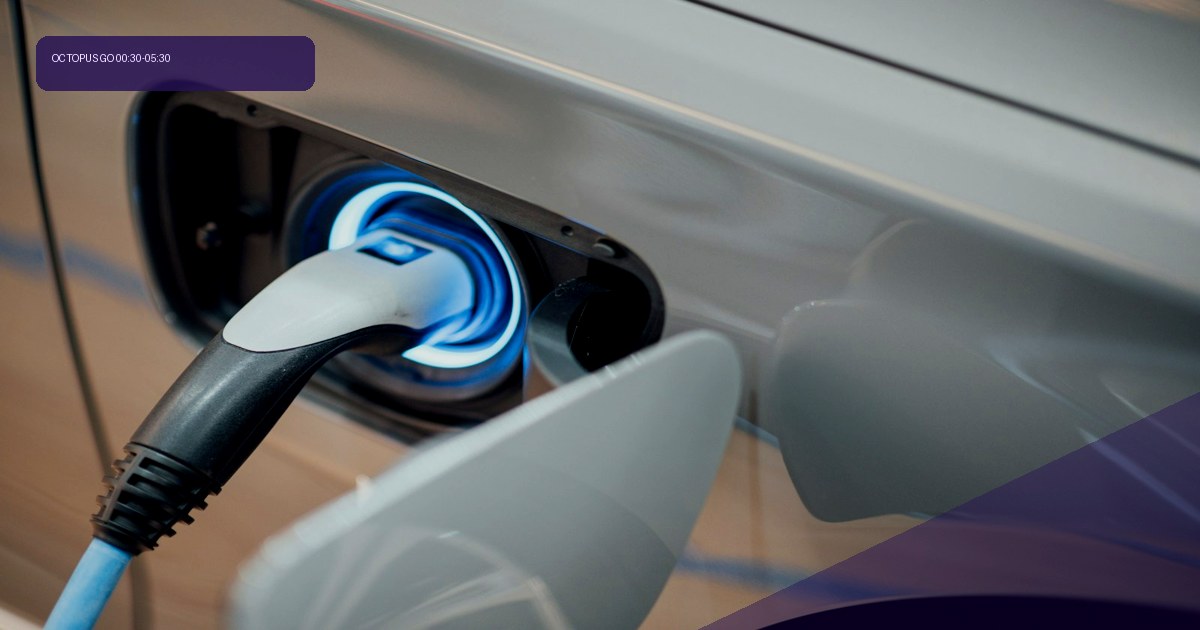
Last updated: Tuesday 15 September 2026 (Europe/London).
Next update: when Octopus reprints Go product codes / regional unit rates, or Ofgem reprints the next quarterly price cap.
By: Switch Editorial Team, Switch Squid Ltd
As of 15 September 2026, Octopus Go (product GO-FIX-12M-26-08-19 on the public Octopus API) still sells a fixed EV-friendly electricity tariff with super-cheap power between 00:30 and 05:30 every night — in London region _C that prints about 9.50p/kWh off-peak and 33.37p/kWh peak, with a 44.12p/day standing charge (all inc VAT from the API unit-rate and standing-charge feeds). Context: Ofgem’s dual-fuel typical Direct Debit cap level for October–December 2026 is £1,723, with electricity unit and standing figures of 26.32p/kWh + 54.83p/day on the published SVT path.
I am Switch. I explain Octopus Go EV tariff from octopus.energy and the public products API — not invented whole-home annual £ figures. Go only wins if you can shift charging (and some household load) into the night window. Compare wider energy deals via MoneySavingExpert’s comparison (Awin campaign 911601) and the energy hub.
Compare energy deals on SwitchSquid →
What Octopus Go is (and is not)
Octopus Go is a time-of-use electricity tariff aimed at home EV charging. The own-page pitch (octopus.energy/go, fetched 15 September 2026) is blunt: cheap electricity between 00:30 and 05:30, compatible with all EVs and chargers, needs a connectable smart meter, and currently emphasises fixed rates while prices are volatile. It is not Intelligent Octopus Go (the longer smart-scheduled window product) and it is not Agile. If your car never plugs in overnight, Go’s elevated day rate will punish you.

London rates table — API snapshot 15 September 2026
| Band | Window (UK local) | Unit rate (inc VAT) | Standing (inc VAT) |
|---|---|---|---|
| Off-peak | 00:30–05:30 | 9.50p/kWh | 44.12p/day |
| Peak | 05:30–00:30 | 33.37p/kWh |
Source: Octopus public API product GO-FIX-12M-26-08-19, electricity tariff E-1R-GO-FIX-12M-26-08-19-C (London). Half-hourly standard-unit-rate results on 15 September 2026 show night bands near 9.50p and day bands near 33.37p; standing charges feed prints 44.122575p/day. Other UK regions differ — always run Octopus’s postcode rate checker. Product description confirms the 00:30–05:30 marketing window.
How this sits vs the Ofgem cap context
Ofgem’s October–December 2026 dual-fuel typical Direct Debit level of £1,723 is a ceiling reference for standard variable tariffs on a typical-use profile — not your EV bill. The published electricity SVT ingredients of 26.32p/kWh + 54.83p/day are the honest flat-rate comparison points. Go’s night 9.50p undercuts that unit rate hard; Go’s day 33.37p sits above it. Standing on the London Go snapshot (44.12p/day) is below the 54.83p/day SVT electricity standing figure — helpful, but not enough to rescue a household that does all its cooking and laundry at 6pm.
I will not invent a fake “typical Go annual £” without your mileage, charger speed and daytime kWh. The maths is personal: (night kWh × 9.50p) + (day kWh × 33.37p) + (365 × 44.12p), then compare with a quoted SVT or fixed from a licensed supplier.
Who Go is for
- Home chargers who plug in every night — the core use case.
- Households that can shift immersion, dishwasher or battery charging into 00:30–05:30.
- Drivers with a 7kW wallbox and a predictable commute — five hours often refills a workday’s miles.
Who should walk away: flat dwellers without overnight charging, pure daytime WFH heavy users with no EV, or anyone whose smart meter cannot connect for half-hourly reads. Octopus’s own Go page lists the meter and EV prerequisites — SMETS2 (and some Secure SMETS1), become an Octopus customer first, accept smart-tariff terms after connection (often ~14 days).

Go vs Intelligent Octopus Go
Intelligent Octopus Go is a different product: longer smart-scheduled cheap charging when your car/charger is on the compatibility list. The standard Go page cross-sells it with a “save 69% vs a standard tariff” marketing line for Intelligent — treat that as Octopus advertising, not an Ofgem figure. If your hardware is supported, compare both quotes in the Octopus account journey. If not, classic Go’s fixed five-hour window is the honest offer.
Gas, export and dual fuel
Go is an electricity time-of-use product. Gas stays on whatever gas tariff you hold. Solar export pairing is restricted — Octopus’s Go page notes you can only pair Go with certain export tariffs. Do not assume Outgoing Agile stacks cleanly; read the smart-tariff terms.
Worked sketch (illustrative, not a quote)
Suppose a London driver shifts 2,500 kWh/year of EV charging into the night window and still uses 2,000 kWh of household electricity in the day band (toy numbers for method only): night cost ≈ 2500 × £0.0950 = £237.50; day ≈ 2000 × £0.3337 = £667.40; standing ≈ 365 × £0.4412 = £161.04; total electricity ≈ £1,065.94 before any dual-fuel discounts. Swap in your app’s kWh splits. Compare with the same kWh on 26.32p flat + 54.83p/day standing from the Ofgem electricity SVT ingredients. That method is E-E-A-T-honest; a made-up “save £400” headline is not.
How to join without surprises
- Check Octopus Go rates for your postcode on octopus.energy/go.
- Confirm smart-meter connectivity eligibility.
- If new to Octopus, expect a switch onto a standard tariff first while meters connect.
- Schedule EV charging for 00:30–05:30 (or use charger schedules).
- Re-check unit rates when Octopus issues a new Go product code — today’s snapshot is GO-FIX-12M-26-08-19.
For a whole-market scan of fixes and SVTs, use MSM’s comparison (Awin 911601) alongside SwitchSquid energy.
Charging maths: 7kW vs 3.6kW vs three-pin grit
A rough overnight fill: a 7kW wallbox can move about 35 kWh across Go’s five-hour window if the car accepts that rate end-to-end — often enough for 100+ miles of efficient EV driving. A granny three-pin lead at ~2–3 kW may only move 10–15 kWh in the same window. If your commute needs 40 kWh overnight, classic Go’s five hours on a slow lead will not cut it — you either need a faster charger, Intelligent Go’s longer smart window, or a top-up at peak rates. That hardware reality matters more than a 0.1p difference on the unit rate.
Preconditioning the cabin while still plugged in during the cheap window is a free range trick in winter. Heating the battery and cabin from the wall at 9.50p/kWh beats using pack energy at motorway speeds after an unplugged start.
Half-hourly data, bill shock and what to watch in the app
Go billing lives or dies on half-hourly smart-meter reads. If the meter drops offline, Octopus’s smart-tariff terms describe fallback behaviour — read them before you assume every night was billed at 9.50p. When you first join, expect a connection period (Octopus’s Go page cites around 14 days as a typical meter-connect window) on a standard tariff before Go activates. Do not schedule a long trip for the week you switch and assume cheap charging is already live.
In the app, watch the split between night and day kWh for the first two bills. If day kWh dominates, either your charging schedule failed or the household load is the real story — dishwashers at 7pm will erase EV savings fast. Move what you can; leave what you must; then decide whether Go still beats a flat SVT at 26.32p.
Regional standing charges and why London is not the UK
The London snapshot is not a national promise. Distribution costs differ by DNO region — standing charges on Go move with them. Always pull the Octopus quote for your postcode. A Scottish or South West standing charge can sit well above London’s 44.12p/day and change the break-even mileage. Unit rates for off-peak/peak also move by region on the same product code family. This guide’s table is a worked London example from the public API on 15 September 2026, not a sticker price for every postcode.
When you compare against the Ofgem £1,723 dual-fuel typical, remember that figure blends gas and electricity for a typical domestic profile. Pure electricity-only or high-mileage EV homes need a kWh-level comparison, not a headline annual.
FAQ
What time is Octopus Go cheap?
Octopus’s Go page and product description: every night between 00:30 and 05:30 UK time.
What are Octopus Go London rates on 15 September 2026?
From the public API for GO-FIX-12M-26-08-19 in London: about 9.50p/kWh off-peak, 33.37p/kWh peak, 44.12p/day standing (inc VAT). Other regions differ.
How does that compare with the Ofgem cap?
Ofgem dual-fuel typical DD for Oct–Dec 2026 is £1,723. Electricity SVT ingredients cited here are 26.32p/kWh + 54.83p/day. Go is cheaper at night and dearer by day — your shift decides the bill.
Do I need a specific charger?
Standard Go is marketed for any EV/charger. Intelligent Octopus Go has a compatibility list.
Do I need a smart meter?
Yes — Octopus needs half-hourly capable connectivity (SMETS2 or eligible SMETS1).
Is there an exit fee?
The London API tariff snapshot shows exit_fees_type NONE / £0 on this product code — still read your quote PDF.
Can I use Go without an EV?
Technically some people chase the night rate for batteries or Economy-7-style loads, but the product is aimed at home EV charging and the day rate is elevated — run the maths before you switch.
Where should I compare other tariffs?
MoneySavingExpert comparison via Awin campaign 911601, plus switchsquid.com/energy/.
I am Switch. EV tariffs reward behaviour — not slogans.