Last updated: Friday 9 October 2026 (Europe/London).
Next update: when Ofgem publishes the price cap for 1 January to 31 March 2027.
By: Switch Editorial Team, Switch Squid Ltd
As of 9 October 2026, if you rent and pay your gas and electricity bills to the supplier yourself, you can switch supplier or tariff without asking your landlord, and the Ofgem price cap of £1,723 a year (about £144 a month) for a typical home runs until 31 December 2026. If your landlord pays the supplier and you pay them through your rent, you cannot switch yourself, but you can ask them to. SwitchSquid explains who can switch, what to check in your tenancy and how to compare deals for your postcode; we may earn a commission if you buy through our links.
Sources: Citizens Advice — switching energy supplier or tariff if you’re renting, Ofgem — energy price cap and standing charges explained and GOV.UK — Renters’ Rights Act overview for tenants.
Compare gas and electricity deals for your postcode (MoneySuperMarket)
- The Ofgem price cap averages £1,723 a year for typical use from 1 October to 31 December 2026, when we checked on 9 October 2026
- Quotes are priced for your postcode and usage, so you can compare fixes against the cap
- Main limitation: you can only switch if you pay the supplier directly, and quotes depend on your postcode and may not include every supplier or tariff
Can you switch energy supplier if you rent?
Often, yes. The question that decides it is simple: who pays the energy supplier? Citizens Advice says that if you pay your supplier directly for your gas or electricity, you can switch supplier or tariff yourself, including if you have a prepayment meter. If your landlord pays the supplier and you pay them as part of your rent, you cannot switch on your own. You would need to ask your landlord, who can agree or refuse.
Your tenancy agreement is the place to check. It should say who is responsible for the bills, and it may also say that you must return the account to the original supplier when you leave. That clause is worth reading before you switch, because it affects what you do at the end of the tenancy, not whether you can switch now.
This advice applies to England. Rules and guidance differ in Scotland, Wales and Northern Ireland, so check the Citizens Advice page for your nation if you live elsewhere.
Who can switch? Common renting situations
| Your situation | Can you switch? | What to check |
|---|---|---|
| You pay the supplier directly (account in your name) | Yes | Your tenancy agreement for any clause about returning the account to the original supplier |
| Landlord pays the supplier (bills in your rent or repaid to them) | No, but you can ask your landlord | Find a tariff you want, explain the saving and ask politely; they do not have to agree. Citizens Advice says to check what your landlord is allowed to charge you |
| Prepayment meter and you pay the supplier | Yes | If you owe nothing, you can move to paying by credit; check if your tenancy says to change the meter back |
| Smart meter in prepayment mode | Yes | Your tenancy may ask you to change the mode back to credit at the end |
If you are not sure which row applies, look at a recent bill. If it has your name on it and you pay the supplier by Direct Debit or top-up, you are the account holder.
Compare deals against the cap for your home
- Typical use at the cap is 2,500kWh of electricity and 9,500kWh of gas a year
- A smaller flat usually pays less, but standing charges take a larger share
- Check exit fees on your current tariff first
What the £1,723 price cap means for a renter
From 1 October to 31 December 2026, Ofgem’s price cap averages about £1,723 a year for a typical dual-fuel home in Great Britain paying by Direct Debit, based on 2,500kWh of electricity and 9,500kWh of gas a year. Ofgem’s Great Britain average rates are 26.32p per kWh and a 54.83p daily standing charge for electricity, and 7.97p per kWh and a 29.68p daily standing charge for gas, which adds up to £1,723.61 at that usage. The cap limits the unit rate and standing charge, not your total bill, so your own bill depends on how much energy you use.
Most renters do not live in a typical home. A small flat uses less, and that makes the standing charges a bigger share of the bill. As an illustration at the Great Britain average rates, a flat using 1,800kWh of electricity and 5,000kWh of gas would pay about £673.89 for electricity (£473.76 for units and £200.13 in standing charges) and about £506.83 for gas (£398.50 for units and £108.33 in standing charges). That is around £1,180.72 a year, and about 26% of it is standing charge. Our guide to standing charges and unit rates explains why that matters when you compare tariffs.
If you share a three-person house at the typical figure, £1,723.61 is about £575 each over a year, or roughly £48 a month each. Region matters too: our energy price cap by region guide shows how the cap differs across Great Britain.
How to switch step by step
- Check the tenancy and the account. Confirm that you pay the supplier and note any clause about returning the account at the end.
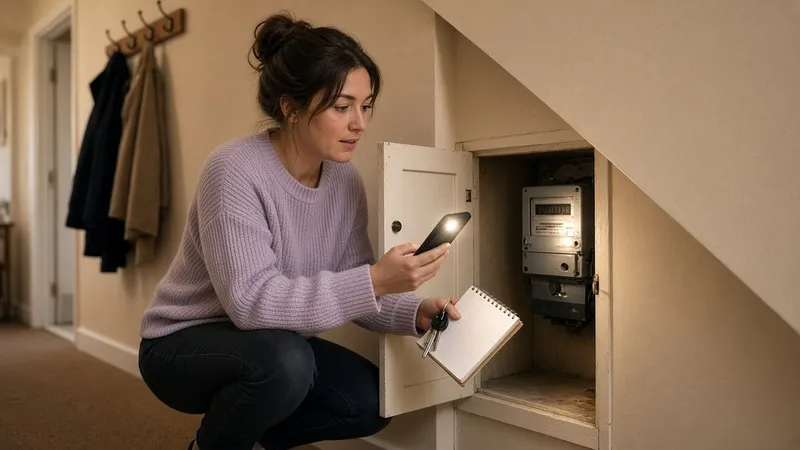
- Take a meter reading. Photograph your electricity and gas meters with the date visible. A reading helps your new supplier start your bills at the right point.
- Find your usage. Use the annual kWh figures from your last bill, or the supplier’s online account if you have moved in recently. If you do not have a year of data, use an estimate that matches your home.
- Compare deals for your postcode. Quotes depend on your region and how you pay, so enter your own details.
- Check exit fees on your current tariff. Ofgem’s rules mean you can usually switch without an exit fee in the last 49 days of a fixed tariff. On a variable tariff there is normally no fee.
- Choose and confirm. Your new supplier takes care of the switch, which is normally complete within five working days, and your supply is not interrupted.
You have a 14-day cooling-off period after agreeing a new contract, so you can change your mind. Keep the confirmation email with your meter readings.
If you have just moved in
When you move into a rented home, you are normally placed on the previous supplier’s default tariff at your address, which sits at or near the price cap. Contact the supplier, give your move-in meter readings and open an account in your name. You can then compare other deals straight away, since there is no minimum period on a default tariff. Our moving house energy guide covers the move itself in more detail.
It is worth taking photographs of the meters on your first day, ideally before you unpack. If there is ever a dispute about what was used before you arrived, a dated photo is the simplest evidence.

Sharing a house: keeping the bills fair
In a house share, one person usually holds the energy account. That person is responsible to the supplier, so agree in advance how the bill will be split, how often people pay in and what happens when someone moves out. A shared note or a standing order to the account holder keeps things simple.
If a housemate moves out, the account holder remains responsible. Take a meter reading on the move-out date so that the new person starts fairly. When it is time to switch, ask everyone to agree to the plan first; the person holding the account is the only one the supplier will deal with.
Prepayment meters and smart meters when renting
You can switch supplier with a prepayment meter if you pay the supplier. If you do not owe money, you can ask to move to paying by credit. Citizens Advice notes that some suppliers may want to put a smart meter into prepayment mode, and your tenancy may ask you to change it back at the end. A landlord can try to keep part of a deposit if you change the meter and they did not want it changed, so read the clause first. Our guides to the prepayment meter and the smart meter explain the basics.
Fit summary
- Good for renters who pay their own supplier: compare deals now, because the cap is the benchmark for anything you are offered from 1 October to 31 December 2026.
- Good for a recent move-in: open an account in your name and compare deals once you have meter readings.
- Consider asking your landlord: if the landlord pays the supplier and you pay through rent.
- Consider checking exit fees first: if you are already on a fixed deal.
Important conditions
- Cap figures are Ofgem’s Great Britain averages for 1 October to 31 December 2026; your own bill depends on your region, usage and payment method.
- You can only switch if you are the account holder paying the supplier.
- Quotes depend on your postcode and usage and may not include every supplier or tariff.
- Your tenancy agreement may say what to do with the account at the end of your stay.
- Prices were as shown when we checked on 9 October 2026 and can change.
- Confirm the unit rates, standing charges and any exit fees before you agree to a deal.
Final decision card
Pay your supplier directly? Compare deals for your postcode and switch if you find a better price.
Landlord pays the bills? Show them the deal and ask whether they will switch.
Just moved in? Open an account in your name, take meter readings, then compare.
Check energy deals for your postcode
- Have your last bill or yearly kWh to hand
- Take a dated meter reading before you switch
- Switching usually takes about five working days and your supply is not interrupted
FAQ
Can I switch energy supplier if my landlord pays the bills?
No, you cannot switch yourself if your landlord pays the energy supplier. You can ask them to switch and explain the saving. They are not obliged to agree.
Do I need my landlord’s permission to switch energy supplier?
Not if you pay the supplier directly. Citizens Advice says you can switch supplier or tariff yourself, including with a prepayment meter. Check your tenancy agreement for any clause about returning the account at the end.
Can I switch to a fixed tariff in a rented home?
Yes, if you hold the account, but a fixed deal may charge exit fees if you leave early. Check the term against how long you plan to stay. Ofgem’s rules mean you can usually switch without an exit fee in the last 49 days of a fixed deal.
How long does it take to switch energy supplier?
A switch is normally complete within five working days, and your supply is not interrupted. You also have a 14-day cooling-off period after agreeing a new contract. Keep your meter readings and confirmation email.
What is the energy price cap from October to December 2026?
Ofgem’s cap averages about £1,723 a year for a typical dual-fuel home paying by Direct Debit, which is around £144 a month. It caps unit rates and standing charges, not your total bill. Your actual cost depends on your usage and region.
What should I do with my energy account when I move out?
Take final meter readings, tell your supplier your leaving date and give a forwarding address for the last bill. If your tenancy says to return the account to the original supplier, follow that. Keep photographs of the meters on the day you leave.