
Last updated: Saturday 5 September 2026 (Europe/London). Next update: when the next round of annual price-change notices goes out. Until then, treat every “no mid-contract rise” claim as something to confirm on the contract summary for the specific deal at your postcode.
Compare live packages on broadband deals — filter for the speed you need, then read the rise line before you trust a “from” price.
BT Full Fibre 900 — check live price
- Full Fibre up to 900Mb path on BT
- Confirm postcode availability and any leaving fees on your account
- Tracked BT affiliate offer — re-check live checkout price
By [Named broadband lead], Switch Squid Ltd Reviewed by [Named reviewer]
I compare broadband deals for a living, and I have a problem with the word “fixed”.
You signed a 24-month contract. You were shown a monthly price. Then April arrived and the bill went up by three or four quid, even though nothing about the service changed. That is not a billing error. It is how most of the big UK brands now sell broadband. Ofcom stopped them hiding the rise behind CPI + 3.9%. It did not stop the rise.
If you want the rights version — the date test, the 30-day window, when you can walk away — I already wrote that here: Broadband mid-contract price rises 2026. This page is the shopping version. Fixed-price broadband UK, properly: a deal where the monthly price you agree on day one is the monthly price you pay until the minimum term ends. No April surprise. No “disclosed” £4 bump dressed up as certainty.
A handful of altnets still sell that. Most of the household names do not. One of the names people still google as a no-rise provider, Hyperoptic, quietly stopped being one.
Three different products
People use “fixed” to mean three different things. Only one of them is the product I am talking about.
1. A genuine fixed-price contract. The monthly price does not change during the minimum term. Zen Internet calls this its Contract Price Promise. YouFibre still publishes the same promise on its site: “Our prices won’t go up mid-contract. Ever.” Coverage is the catch. These are mostly smaller full-fibre networks. If they do not pass your door, you cannot buy the lock.
2. A disclosed pounds-and-pence rise. This is what BT, EE, Virgin Media, TalkTalk, Vodafone and most of the rest now sell. Ofcom’s rule, in force from 17 January 2025, bans inflation-linked or percentage-based rises in new contracts. Any rise written into the contract has to be stated in pounds and pence, prominently, at the point of sale, with a date. That is transparency. It is not a price lock. A BT broadband plan on current terms still goes up by £4 a month on 31 March each year while you are in the minimum term. You were told. You still pay it.
3. A leftover inflation clause. If you signed before your provider moved to pounds and pence, you may still be on CPI or RPI plus a few extra percent. The Office for National Statistics put CPI at 3.4% in the 12 months to December 2025, which is the figure most CPI-linked April 2026 rises used. Add the typical 3.9% provider margin and you get 7.3%. The government’s Telecoms Consumer Charter says April 2026 is the last time signatories apply those inflation-linked terms to the core subscription. After that, leftover customers move onto pounds and pence too. Clearer. Not cheaper.
Ofcom itself is honest about the split. When the pounds-and-pence rule landed, it said several providers already offer contracts that do not contain price rises, and that some others still permit unspecified rises — in which case they must give 30 days’ notice and a penalty-free exit. The big brands mostly picked option two: tell you the £3 or £4 in advance, keep the rise.
What went up in spring 2026
I am not going to invent a live “from £24.99” table. Headline prices move by postcode, by the day, and by whether you already have a TV box in the loft. The rise amounts are in the providers’ own terms. Those are what you need for the comparison.
Provider | What new / recent contracts disclose | Older contracts still in term | Can you leave for free when it lands? |
|---|---|---|---|
BT / EE | £4/month on broadband (current rate). Contracts taken 10 Apr 2024–30 Jul 2025 were on £3/month. In-contract rise: 31 March. Out of contract: from 1 March 2026. | BT has been moving leftover out-of-contract customers off CPI + 3.9% onto pounds and pence. | No, if the rise matches what you were shown. |
Plusnet | £4/month from contracts starting 5 Aug 2025; £3/month from 11 Jul 2024. | CPI + 3.9% = 7.3% in April 2026, using the December 2025 CPI of 3.4%. | No, if disclosed / in the old clause. |
Virgin Media | £4/month from 2 Oct 2025; £3.50/month from 9 Jan 2025. | RPI + 3.9%. uSwitch puts the 2026 inflation-track rise at 7.7%. | No, if disclosed / in the old clause. |
TalkTalk | £4/month from 16 Nov 2025; £3/month from 12 Aug 2024. | CPI + 3.7%. | No, if disclosed / in the old clause. |
Vodafone | £3.50/month from 12 Nov 2025; £3/month from 2 Jul 2024. | CPI + 3.9% = 7.3%. | No, if disclosed / in the old clause. |
Sky | No set annual formula. £3/month on broadband from 1 April 2026 (uSwitch; first year Sky has used a flat pounds figure rather than a percentage). TV extras separately, £1–£3. | Same discretionary model. | Yes, on broadband, within 30 days of the notice. uSwitch says that 2026 window has already closed. TV in a bundle is a different contract. |
Hyperoptic | uSwitch: £3/month from 3 Jun 2025; £4/month from 5 Jan 2026. Hyperoptic’s own residential terms (effective 16 Jul 2026) say it can change prices at any time with email notice. | Older “no mid-contract rise” marketing does not apply to those newer contracts. | No, if the rise was in the contract you signed. |
Community Fibre | uSwitch: £3/month from contracts starting 6 May 2026. | Older CPI + 2.9% track still listed by uSwitch. | No, if disclosed. |
Social tariffs (BT Home Essentials, BT Basic, and other benefits tariffs) | BT’s own page: no annual price change on BT Basic and Home Essentials with BT broadband. Ofcom: social tariffs generally do not include mid-contract rises. | — | Usually rolling, and built to be leavable. See the social tariff guide below. |
Zen Internet, YouFibre, and the uSwitch no-rise list | £0. Price on day one for the minimum term. | — | Rise is not in the contract, so the April problem does not arise. |
BT Full Fibre 900 — check live price
- Full Fibre up to 900Mb path on BT
- Confirm postcode availability and any leaving fees on your account
- Tracked BT affiliate offer — re-check live checkout price
Sources for that table: BT price changes explained, BT annual price change, BT’s June 2026 consumer price guide, uSwitch’s 2026 mid-contract table (updated 30 April 2026), ONS CPI January 2026 bulletin, Zen Contract Price Promise, YouFibre.
Two footnotes, because they catch people out.
BT still lists “Fixed price broadband plans” as exempt from the annual change, alongside BT Basic and Home Essentials. That is a real product line on BT’s own help page. It is not every BT deal. Most BT broadband on sale still carries the £4 rise. If a comparison card says “fixed price” next to a BT result, open the contract summary.
Hyperoptic used to campaign against mid-contract rises. It does not, on current terms. If you are still repeating “Hyperoptic never raises prices” from a 2024 blog, stop. Check the date you signed.
The cost of a £4 rise
I am not going to pretend I know the cheapest BT Full Fibre 100 at your postcode this morning. I can show you what the rise costs, because BT has published the amount.
Sign a 24-month deal in August 2026 with a disclosed £4 increase every 31 March:
Period | Months | Extra v headline |
|---|---|---|
Aug 2026 – Mar 2027 | 8 | £0 |
Apr 2027 – Mar 2028 | 12 | £4 × 12 = £48 |
Apr 2028 – Jul 2028 | 4 | £8 × 4 = £32 |
24-month total extra | 24 | £80 |
That is £3.33 a month on top of whatever headline you were sold, before setup fees. Do it on a 24-month deal signed just after April and you cop two full years of the higher rate. The extra is then £96 (£4 × 12, then £8 × 12).
uSwitch, looking at live Virgin Media cards on 6 August 2026, made the same point in plainer language: once you add the two in-contract rises, the effective monthly price of Virgin’s M125 package was over £3 a month higher than the initial monthly cost. That is the comparison the advert does not want you to do.
A slightly dearer altnet with a genuine lock often wins over two years. Sometimes it does not — if the lock is £8 a month more than the big brand’s average monthly cost, the maths flips. That is why I will not tell you “always pick the no-rise deal”. I will tell you to run the average, not the day-one price, and to do it at your postcode.
If you are still on an inflation-linked leftover, uSwitch’s 7.3% ready-reckoner for April 2026 is the one I will use rather than inventing a third:
Monthly bill before the rise | 7.3% extra (CPI 3.4% + 3.9%) | Extra over 12 months |
|---|---|---|
£20 | £1.46 | £17.52 |
£30 | £2.19 | £26.28 |
£40 | £2.92 | £35.04 |
£50 | £3.65 | £43.80 |
Those percentages are for the old clauses. A flat £4 on a cheap 36 Mbps line is a much fatter percentage than the same £4 on a gigabit bundle. Ofcom banned the mystery formula. It did not ban the poll tax.
Who sells no-rise broadband
uSwitch’s August 2026 fixed-price page is the best public snapshot of the no-rise panel. I have not independently audited every regional network on it. I have checked the two national-ish names people actually search.
Zen Internet. Nationwide over Openreach (and CityFibre in some areas). The Contract Price Promise is the price on day one for the life of the contract. After the minimum term, Zen may raise an out-of-contract price with at least 30 days’ written notice. Customers who started on or before 31 May 2022 can still be on the older Price for Life, but only while they stay on that package. A house move or a new contract puts you on the Promise, not Life.
YouFibre. Own-network full fibre. Its March 2025 explainer is still live, and the line is unchanged: prices will not go up mid-contract, and at renewal you get the same deals as new customers. Confirm that on the order summary. Marketing pages age; the PDF you tick does not.
The rest of uSwitch’s August 2026 no-rise list, to be taken as a coverage check rather than a shopping list: Trooli, Squirrel Internet, BeFibre, Earth Broadband, Voneus, Wessex Internet, Fiber Zone, Connect Fibre, Hull Fibre, Link Broadband, Truespeed, Open Fibre, Quickline, Infinics, Yayzi, Utility Warehouse, Brawband, Brillband, Fibrus, G Network, Lit Fibre, Zzoomm, Lightspeed Broadband.
I am deliberately not putting Hyperoptic or Community Fibre in that list. uSwitch’s own mid-contract table now gives both of them a pounds-and-pence rise for newer contracts. Choose.co.uk had Community Fibre on a time-limited fixed-price promo that ran to 2 February 2026. If a London comparison still flashes “no mid-contract rise” against Community Fibre, read the start date on the tariff.
Altnets have three other habits that matter more than the brand name:
Most of them are full fibre only. If you have been on FTTC copper from a street cabinet, this is often a genuine upgrade, not a lateral move. Ofcom said around eight in ten UK homes now have access to full fibre, and that average broadband prices in the market fell 6% in real terms last year, with the faster packages dropping most. The lock and the speed sometimes arrive together.
Most of them do not sell Sky Sports. If the household is a bundle household, a no-rise altnet plus a standalone stream can still be cheaper. It can also be a faff. Be honest with yourself before you “save” £4 a month and spend Saturday re-logging every app.
Coverage is a postcode fact, not a vibe. Use the broadband coverage checker and then. If nothing no-rise appears, you are not failing at shopping. They are not in the street.
Social tariffs
This is not a rewrite of the social tariff guide. It is the overlap that the “fixed price” search misses.
Ofcom’s pricing research, last updated 30 June 2026, found 532,000 customers on a social tariff in June 2025, up 26,000 on the year. There are more than 30 such tariffs, typically £12.50 to £24 a month for broadband, up from three tariffs in 2020. 70% of eligible households did not know they existed as of October 2025. Ofcom also says these cheaper packages for people on certain benefits do not include mid-contract price rises.
If someone in the home is on Universal Credit, Pension Credit, ESA, JSA, Income Support or (at some providers) PIP, check broadband social tariff deals before you fall in love with an altnet. A £15 rolling social tariff with no rise and no exit fee beats a “fixed” 24-month gigabit you do not need.
Should you switch?
Not automatically. A lock is one line on the scorecard.
Switch, or at least compare, if:
You are out of contract. Ofcom says 28% of broadband customers are. In-contract customers spend £7 to £9 a month less, on average, than out-of-contract ones. That gap narrowed last year. It is still a gap. Out-of-contract is where providers hide.
You have 18–24 months of a disclosed £3–£4 rise still in front of you, and a no-rise full-fibre deal is available at the same or a better speed, and the early-termination maths works. Do that sum with the remaining months × current monthly price, then subtract any altnet incentive. If it does not work, wait. I would.
You are with Sky, you are inside the 30-day notice window for a future rise, and you actually want to leave. For April 2026 that window has passed.
You qualify for a social tariff. That is the cleanest no-rise in the market.
Stay put, or re-contract with the same provider, if:
The only no-rise networks at your address are slower than you need, or they want an installation you cannot do (flat, landlord, listed building).
You are inside a minimum term, the rise was properly disclosed, and the exit fee is larger than the saving. Then the move is at contract end, not this afternoon. Set a reminder. Ofcom made providers send end-of-contract notifications for a reason.
You actually use the TV bundle. Do not unpick a working Sky or Virgin stack to chase a £4 lock and then buy the sport back at retail.
One Touch Switch, in force since September 2024, is the process. Ofcom says more than 2 million customers have used it, and 18% of households switched internet provider last year, up from 14% in 2023. Your new provider handles the old one. Walkthrough: How to switch your broadband provider. If you are trying to leave early for a reason other than a no-rise hunt, use Can I leave my broadband contract early?.
And if you are already in a contract and the April letter has landed, go back to the mid-contract price rises guide. That is the rights page. This is the “don’t buy another one of those” page.
How I compare fixed deals
When you run a search on Switch’s broadband hub, ignore the first monthly number until you have four other facts:
Is there a mid-contract rise, in pounds, with a date? If yes, write the average monthly cost over the full term, not the teaser.
Setup or delivery fee? A “free” first month that comes with a £30 kit charge is not free.
Minimum guaranteed speed, not the “up to”. Full fibre vs FTTC is explained here.
What happens on day 25? Out-of-contract prices are a second rise. A true lock that expires into a decent re-contract path (YouFibre’s “same deals as new customers” line, if it is still in the terms) is worth more than a lock that dumps you onto a loyalty penalty.
I rank by total annual cost, not commission. That is the whole point of this site. If a no-rise altnet is available at your address, it will show. If it is not, I will not invent one.
While you are in the bills drawer, it is a reasonable moment to check energy deals as well. Different market, same habit: the advertised number is not always the number you pay in month 14. The bills and cost of living hub sits both next to each other.
What I am not telling you
I am not telling you that Ofcom banned mid-contract rises. It banned unpredictable ones.
I am not telling you that every altnet is a saint. Small networks go bust, get bought, and change terms. Read the current summary.
I am not giving you a cheapest-kWh-style ranked list of live packages. Those rot by Tuesday. The filter that does not rot is: does this contract raise the price before the minimum term ends?
If the answer is yes, you do not have fixed-price broadband. You have a calendar.
BT Full Fibre 900 — check live price
- Full Fibre up to 900Mb path on BT
- Confirm postcode availability and any leaving fees on your account
- Tracked BT affiliate offer — re-check live checkout price
FAQs
What is fixed-price broadband in the UK?
A broadband contract where the monthly price you agree at sign-up does not change during the minimum term. Ofcom’s January 2025 rule does not create that product. It only forces any in-contract rise to be written in pounds and pence up front. A BT deal that says “£4 extra every 31 March” is a disclosed rise, not a fixed price.
Which providers offer broadband with no mid-contract price rise?
As of August 2026, none of the big household names do it as standard. Zen Internet’s Contract Price Promise and YouFibre’s published “won’t go up mid-contract” line are the two I have checked on the providers’ own sites. uSwitch’s August 2026 list adds a long tail of regional altnets. Availability is by postcode. Hyperoptic and Community Fibre should not be assumed to be on that list any more.
Did Ofcom ban April broadband price rises?
No. From 17 January 2025, new contracts cannot use CPI, RPI or any percentage formula. Providers can still put a fixed pounds-and-pence rise in the contract. If they do, and they showed it to you at sale, you generally cannot leave penalty-free when it lands. If they raise by a different amount or on a different date, or they never specified a rise, you get notice and a penalty-free exit.
How much did broadband go up in April 2026?
On current BT / EE terms, £4 a month on broadband plans, applied 31 March for customers in minimum term. uSwitch’s 2026 table puts Virgin Media at £3.50 or £4 depending on start date, Sky at £3, Vodafone at £3 or £3.50, TalkTalk at £3 or £4. Leftover inflation-linked contracts using December 2025 CPI at 3.4% plus 3.9% rose by 7.3%. Your own letter is the number that matters.
Is a more expensive no-rise deal cheaper over two years?
Often, not always. A disclosed £4 rise on a 24-month contract signed in August 2026 adds £80 over the term (£3.33 a month extra versus the headline). If the no-rise alternative is more than that much dearer, month after month, the big brand still wins on cash. Run the average. Do not eyeball day one.
Can I get fixed-price broadband if I rent or move house?
You can buy it, but a house move usually means a new contract. Zen is explicit: keep the service after a move and you start a new Contract Price Promise, and you lose Price for Life if you still had it. Check the provider’s moving-home terms before you treat a 24-month lock as portable.
Do social tariffs rise in April too?
Ofcom says the cheaper packages for people on certain benefits do not include mid-contract price rises. BT’s own annual-change page excludes BT Basic and Home Essentials. Eligibility is by benefit, not by credit score. Start with the social tariff guide.
When is the next broadband price rise?
The big brands still cluster on 31 March (BT Group) and 1 April (most others). Notices usually go out in January or February. The Consumer Charter says April 2026 is the last inflation-linked core-subscription rise for signatories; it does not say it is the last £3–£4 rise. Budget for another pounds-and-pence increase in spring 2027 unless you are on a genuine lock or a social tariff.
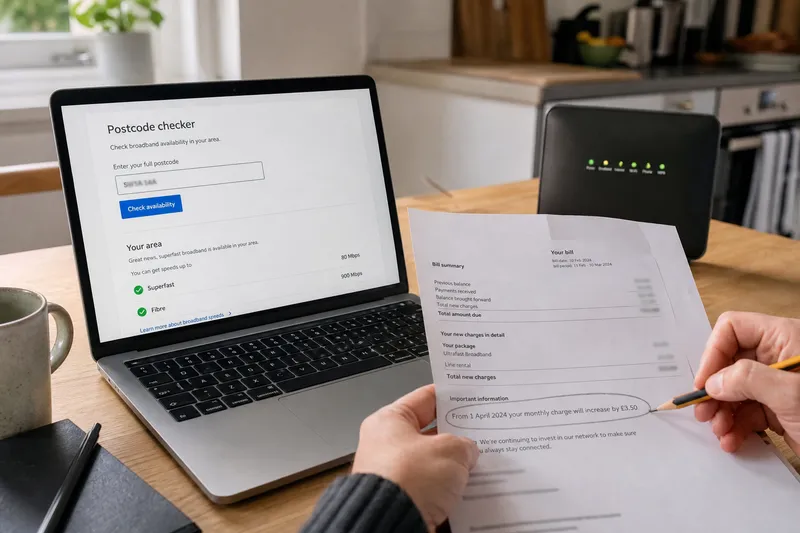
Compare at your postcode
Enter your postcode on the. Filter for deals with no mid-contract price rise if the filter is there; if it is not, read the price-rise line on each card. I show total cost, including the rises the advert leaves in the footnote.
If a true lock is available on full fibre, that is usually where I would start. If it is not, do not pay a loyalty penalty waiting for one. Re-contract or switch at the end of the term, and do not sign another 24 months without looking at the April line.
Sources
Ofcom, “Ofcom bans mid-contract price rises linked to inflation”, 19 July 2024 — https://www.ofcom.org.uk/phones-and-broadband/bills-and-charges/ofcom-bans-mid-contract-price-rises-linked-to-inflation
Ofcom, “Protecting consumers from uncertain and volatile inflation”, 17 January 2025 — https://www.ofcom.org.uk/phones-and-broadband/bills-and-charges/protecting-consumers-from-uncertain-and-volatile-inflation
Ofcom, “New Ofcom research reveals how to cut phone and internet bills”, published 26 February 2026, last updated 30 June 2026 — https://www.ofcom.org.uk/phones-and-broadband/bills-and-charges/new-ofcom-research-reveals-how-to-cut-phone-and-internet-bills
ONS, “Consumer price inflation, UK: January 2026”, released 18 February 2026 — https://www.ons.gov.uk/economy/inflationandpriceindices/bulletins/consumerpriceinflation/january2026
BT, “BT price changes explained” — https://www.bt.com/help/account-and-billing/price-changes-explained
BT, “Annual price change” — https://www.bt.com/help/account-and-billing/about-annual-price-changes
BT newsroom, “Our approach to our annual price change 2026”, 16 January 2026 — https://newsroom.bt.com/our-approach-to-our-annual-price-change-2026/
BT Consumer Price Guide, 26 June 2026 — https://www.bt.com/content/dam/bt/storefront/pdfs/BT_PhoneTariff_Residential.pdf
uSwitch, “Fixed Price Broadband Deals in August 2026” — https://www.uswitch.com/broadband/fixed-price-broadband/
uSwitch, “Broadband price rises in 2026 explained”, updated 30 April 2026 — https://www.uswitch.com/broadband/guides/mid-contract-price-rises/
uSwitch, Sky price increase 2026 — https://www.uswitch.com/broadband/guides/sky-increasing-prices-what-consumers-can-do/
Zen Internet, Contract Price Promise — https://www.zen.co.uk/contract-price-promise
Zen Internet, “Understanding in contract broadband price rises”, 21 January 2026 — https://www.zen.co.uk/blog/posts/zen-blog/2026/01/21/understanding-in-contract-broadband-price-rises/
YouFibre, “Why broadband prices still rise mid-contract”, 3 March 2025 (page still live) — https://www.youfibre.com/news/mid-contract-broadband-price-rises/
Hyperoptic, Residential Customer Terms of Service, effective 16 July 2026 — https://www.hyperoptic.com/legal/residential-customer-terms-of-service
GOV.UK, Telecoms Consumer Charter — https://www.gov.uk/government/publications/telecoms-consumer-charter/telecoms-consumer-charter
Choose.co.uk, “Fixed price broadband: who offers it in 2026?” — https://www.choose.co.uk/broadband/guide/fixed-variable-prices/ (used only for the Community Fibre promo end-date of 2 February 2026)