

Last updated: Wednesday 9 September 2026 (Europe/London)
9 September 2026 refresh: from 1 October the 0% electricity / 5% gas VAT split is live in Great Britain (NI caveat unchanged). October typical dual-fuel is £1,723. Compare on the energy hub or read the October cap guide.
Compare home energy deals
- MoneySuperMarket residential gas & electricity journey
- Enter your postcode and usage for live quotes
- Household switch path only — not business energy
7 September 2026 refresh: from 1 October the 0% electricity / 5% gas VAT split is live in Great Britain (NI caveat unchanged). October typical dual-fuel is £1,723. Compare on the energy hub or read the October cap guide.
From 1 October 2026, VAT on the electricity half of a Great Britain household bill is due to drop from 5% to 0%. VAT on gas stays at 5%. That is the policy. It is not a 5% off your whole dual-fuel bill, and it is not a rebate you apply for.
We wrote this as a bill-impact guide, not another price-cap countdown. Ofgem published the October cap on 26 August 2026 at a typical dual-fuel Direct Debit figure of £1,723. Ofgem says without the VAT cut the headline would have been about £45 higher. The tax cut is a different lever, and it treats electric heating, dual fuel and a heat pump in three different ways. That is the bit most comparison sites have skipped.
You do not need to switch to get the VAT change. You might still want to switch. A competitive fixed tariff moves more money than this tax cut. The cut just changes the arithmetic underneath.
What changes on 1 October
On 21 July 2026 the government announced that VAT on domestic electricity in Great Britain would fall from 5% to 0% from 1 October, in time for the next Ofgem price cap. The official estimate is around £45 off the yearly price-cap figure for a typical household. The same statement said the cut is funded for this financial year, and that any longer-term decision sits with the Budget.
HMRC’s public list of VAT rates still showed electricity at 5% when it was last updated on 10 July, ten days before the announcement. Treat the 21 July GOV.UK statement as the policy, and treat your October bill as the proof. EDF has already said it will apply 0% automatically from 1 October, including on fixed tariffs. Other suppliers are expected to do the same. The government has told them to.
VAT is charged on the whole electricity supply, not just the units. HMRC Notice 701/19 is blunt about this: where the supply qualifies, the reduced rate covers the standing charge as well as the kWh. From 1 October that whole electricity bundle is due to carry 0% instead of 5%. Gas keeps the 5% reduced rate.
Who gets 0%
Great Britain households. England, Scotland and Wales. Domestic electricity on a standard variable tariff, a fixed tariff, prepayment, Economy 7, an EV tariff or a heat-pump tariff. The government expects the cut to be passed through to all of those, including people who locked a rate last spring.
Northern Ireland. Not automatically. GOV.UK is explicit: under the UK’s EU exit terms, EU VAT rules still apply in Northern Ireland on goods, including electricity, so a UK-only 0% rate cannot just be switched on. The Northern Ireland Executive is due comparable funding so households there get equivalent cost-of-living support. If you are in NI, watch the Executive, not your supplier’s GB tariff page. We keep a separate Northern Ireland energy hub for that market.
Gas, heating oil, LPG, coal. Still 5% for qualifying domestic use, unless the government later says otherwise. It has not.
Most businesses. Still 20% VAT on electricity, plus Climate Change Levy where it applies. The 0% rate follows the existing reduced-rate rules, not a new business giveaway. GOV.UK says small businesses that already qualify for domestic-rate energy VAT and are not VAT-registered will benefit, as will charities and residential care homes on the reduced rate. If you are VAT-registered and reclaim the tax in full, a move from 5% to 0% is mostly a paperwork change. If you pay 20% today, this announcement does not cut it. Compare business energy on the commercial rates, not the household cap.
Public EV charging. Still 20% on HMRC’s current policy. Revenue and Customs Brief 4 (2026) followed a First-tier Tribunal case and restated the line: public charge points are not domestic premises. Home charging on your household supply follows the domestic electricity rate, so that is the bit that moves to 0%. The lamp-post charger on the high street does not.
Supply | VAT now (to 30 Sep 2026) | VAT from 1 Oct 2026 (announced) |
|---|---|---|
Household electricity, Great Britain (units and standing charge) | 5% | 0% |
Household gas, Great Britain | 5% | 5% (unchanged) |
Northern Ireland household electricity | 5% (EU VAT rules) | Not the GB 0% rate; equivalent funding to the Executive |
Most business electricity | 20% | 20% (unchanged) |
Qualifying reduced-rate electricity (de minimis, charity non-business, some care homes) | 5% | 0%, if the existing qualification still holds |
Public EV charge points | 20% (HMRC policy) | 20% (HMRC policy, under appeal) |
Compare home energy deals
- MoneySuperMarket residential gas & electricity journey
- Enter your postcode and usage for live quotes
- Household switch path only — not business energy
Sources: GOV.UK, 21 July 2026; HMRC Notice 701/19; HMRC Brief 4 (2026); HMRC VAT rates list (last updated 10 July 2026).
Work out your own VAT
Ofgem’s published cap rates already include 5% VAT. The July to September 2026 Direct Debit averages for Great Britain are 26.11p/kWh for electricity and 57.19p a day for the electricity standing charge.
If a figure is VAT-inclusive, the tax inside it is 5/105 of the total, not 5% of it. That is why a 5% VAT cut is not a 5% off the number printed on the cap.
Formula, for any electricity total that currently includes 5% VAT:
VAT you are paying now = electricity charges (units + standing charge) × 5 ÷ 105
From 1 October, that line should fall to zero on qualifying GB electricity. The underlying unit rate can still move if you are on a standard variable tariff, because the cap is reviewed the same day. The tax cut and the cap are not the same event. We have a separate October 2026 price cap briefing for the cap itself.
The table below uses current July–September cap rates and Ofgem’s Typical Domestic Consumption Values from 1 July 2026 (Profile Class 1: 1,600 / 2,500 / 3,800 kWh a year). It is not a forecast of October’s unit rates. It shows how the tax scales with how much electricity you actually use.
Annual electricity use (Ofgem TDCV) | Electricity charges at July–Sep 2026 cap rates (incl. 5% VAT) | VAT in that total (5/105) | What 0% VAT removes, if rates stayed as now |
|---|---|---|---|
Low, 1,600 kWh | £626.50 | £29.83 | £29.83 |
Medium, 2,500 kWh | £861.49 | £41.02 | £41.02 |
High, 3,800 kWh | £1,200.92 | £57.19 | £57.19 |
Method: 26.11p/kWh and 57.19p/day × 365, then × 5/105. Rates from Ofgem, July–September 2026, VAT-inclusive, Direct Debit, GB average. TDCVs from Ofgem’s 1 July 2026 review. Standing-charge VAT alone is £9.94 a year at these rates, for every household on this average standing charge, even if you used no units at all.
The government’s “around £45” is an estimate against the October cap for a typical household, not a promise that your bill falls by £45. Use your own annual electricity kWh from the last statement. If you cannot find it, how energy bills work walks the line items.
Dual fuel vs electric-only
This is the part that gets flattened in the headlines.
A typical dual-fuel home still pays VAT on gas. Using the same July–September Direct Debit averages (gas 7.33p/kWh and 29.04p/day) and Ofgem’s medium gas TDCV of 9,500 kWh:
Gas charges, VAT-inclusive: £802.35
VAT remaining on that gas: £38.21
So a medium dual-fuel household, on these rates, currently pays about £41 of VAT on electricity and about £38 of VAT on gas. From 1 October the electricity £41 is the bit that should disappear. The gas £38 does not. Calling that “VAT taken off energy bills” is sloppy. It is VAT taken off electricity.
An electric-only home has no gas VAT left behind. Flats with storage heaters, new-builds without a gas pipe, and anyone who already heats with electricity keep the whole tax cut. They also use more electricity, so the 0% rate is worth more in cash. That is why a high-use electric-only household on 3,800 kWh sits at about £57 in the table above, against about £41 for a medium dual-fuel electricity share.
If you are on dual fuel and shopping around, compare the electricity and gas legs separately as well as the bundle. A cheap dual-fuel tariff is still the right answer for most gas-heated homes. It is not automatically cheaper than splitting the fuels. We rank both on dual fuel energy and in the dual-fuel tariff guide.
Heat pumps vs gas boilers
The government said it targeted electricity so more people would be supported and to help keep inflation down. The side-effect, which it did not labour, is that the tax system now treats a heat pump more kindly than a gas boiler for the length of this measure.
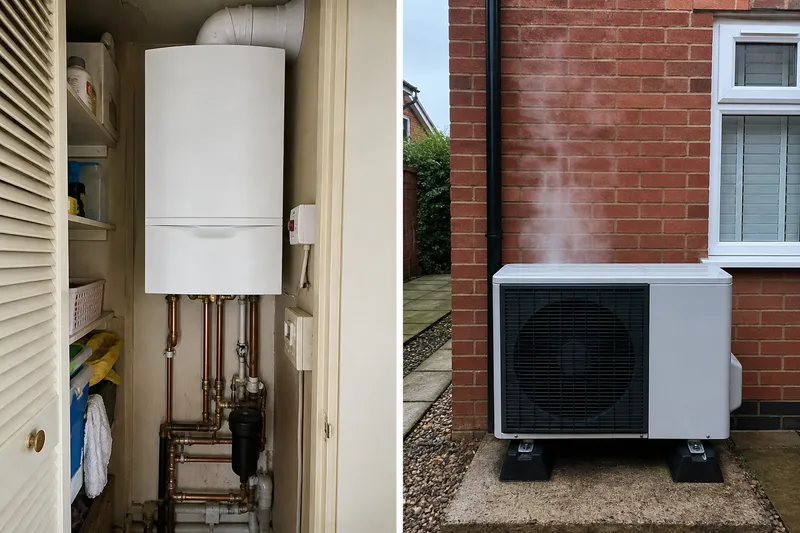
A gas boiler still burns gas, and gas keeps 5% VAT. A heat pump uses electricity, and that electricity is due to go to 0%.
We are not going to pretend there is one official “heat pump kWh” figure. There isn’t. What we can do is show the direction of travel with numbers that are sourced.
Energy Saving Trust puts a typical heat-pump seasonal performance factor at about 3.1, and a typical new gas boiler at about 85% efficient. Take Ofgem’s medium gas TDCV of 9,500 kWh as a gas-boiler household’s annual gas use. The heat that boiler delivers is 9,500 × 0.85 = 8,075 kWh. A heat pump at SPF 3.1 would draw about 2,605 kWh of electricity to deliver the same heat. Add Ofgem’s medium electricity TDCV of 2,500 kWh for lights and appliances and you are around 5,105 kWh of electricity in total.
At July–September cap rates, VAT on 5,105 kWh of electricity is about £73. That is the tax a heat-pump household would stop paying if rates stayed as they are. The equivalent gas-boiler household keeps paying about £38 of VAT on the gas, and only sheds the electricity £41.
Two caveats, both real:
Heat-pump running costs still depend on the tariff. EST’s own research has said a heat pump on a standard flat rate can cost about the same as a gas boiler, and that a heat-pump time-of-use tariff is what usually tips it. The VAT cut does not replace that tariff choice. It makes the electricity side a little cheaper, whichever tariff you are on.
October unit rates will not be July’s rates. The cash VAT saving moves with the electricity total. The relative point stands: more of a heat-pump bill is electricity, so more of it loses the 5%.
If you already have a heat pump, or you are about to, the useful move this autumn is still the tariff, not the tax. Look at the unit rate at the hours you actually heat, not the headline cap. Our cheapest kWh guide is the place to start, then compare live deals.
Standing charges
Standing charges are the daily fee for being connected. You pay them if you go away for a fortnight. You pay them in a heatwave. Ofgem’s July–September electricity standing charge average is 57.19p a day including VAT, which is £208.74 a year. Of that, £9.94 is VAT.
From 1 October that £9.94 should drop out of the electricity standing charge. The gas standing charge (29.04p a day including VAT, about £106 a year, of which £5.05 is VAT) does not get the same treatment.
This matters more if you are a low user. On 1,600 kWh, almost a third of the electricity VAT in our table is standing-charge tax. On 3,800 kWh it is closer to a sixth. A 0% rate on standing charges is one of the few bill changes that helps a small flat in the same direction as a large house, even though the unit saving still favours higher use.
Regional standing charges still differ. The figures above are GB averages. Your bill will show the rate for your electricity distribution region.
Fixed, variable and prepayment
The government expects every supplier to pass the cut to every household customer, including people on fixed tariffs. That is the same approach used when £150 of costs were taken off bills at the last Budget.
If you are on a standard variable tariff, two things happen on 1 October: the cap rates change, and electricity VAT goes to 0%. One can offset the other. Do not read a lower-looking electricity unit rate as proof that wholesale costs fell. Ofgem’s published rates have included 5% VAT. From October the electricity side should be published without that 5%.
If you are on a fixed tariff, your contracted unit rates and standing charges do not follow the cap. The VAT rate on top of them does. You should see the tax cut on electricity used from 1 October without changing tariff. You do not need to wait for the cap announcement to get it.
If you are on prepayment, the same VAT rule applies to qualifying domestic electricity. The cap for prepayment is a separate Ofgem calculation; the tax is not.
None of that is a reason to sit on a poor tariff. The VAT cut is tens of pounds. A switch can be hundreds. We still think most households on a default tariff should compare fixed and variable deals before winter, then run a comparison. Our take on whether to lock a rate is in should I fix my energy deal.
Timing with the October cap
The government timed the cut “in time to impact the next Ofgem price cap”. Ofgem has said the 1 October to 31 December 2026 levels will be published by 26 August 2026. That is Wednesday.
We are not restating cap forecasts here. Wholesale gas has been noisy all summer, and a tax cut on electricity only does not rewrite a dual-fuel cap. What you need for this piece is simpler: the 0% rate is real even if the headline bill does not fall. A bill that would have been higher without the cut is still a cut. It just may not look like one on the payment page.
Current July–September cap rates, and how we got here, are in our July 2026 price cap guide. October’s number belongs in the October cap briefing.
How long 0% lasts
GOV.UK says the measure is funded for this financial year, with any further action taken at the Budget. The UK financial year ends on 31 March 2027. BBC News reported business secretary Jonathan Reynolds saying the cut is funded until the end of the financial year in March 2027, and that anything beyond that would need a Budget decision.
So: plan on 0% VAT on GB domestic electricity from 1 October 2026 through the rest of 2026-27, and do not bake it into a 2027-28 household budget until the Budget says so. If you take a 24-month fix in September, ask how the supplier will treat electricity VAT if the 0% rate expires during the term. They should be able to answer that in one sentence.
What to do this week
You cannot claim the VAT cut. You can make sure it shows up, and you can stop treating £45 as the plan for winter.
Find last year’s electricity kWh on a bill or in the app. Multiply the VAT-inclusive electricity total by 5/105 if you want a personal figure on today’s rates.
Submit a meter reading on 1 October, or the nearest weekday, even if you have a smart meter. Bills that straddle 30 September and 1 October will mix two VAT rates. An actual reading makes the split cleaner.
Check the VAT line in October. Electricity should show 0%. Gas should still show 5%. If both still show 5%, raise it with the supplier in writing and keep the bill PDF.
Do not switch for the VAT. Switch if the tariff is wrong. Rank by annual cost for your usage, not by who mentions the tax cut in the email.
If you heat with electricity, including a heat pump, put more effort into the tariff than into the tax. The 0% rate helps. The unit rate at 6pm in January helps more.
If you are already behind on the account, this cut will not clear the balance. Speak to the supplier before the first cold week. They have to offer a plan if you ask.
Compare home energy deals
- MoneySuperMarket residential gas & electricity journey
- Enter your postcode and usage for live quotes
- Household switch path only — not business energy
Frequently asked questions
How much VAT is on electricity in the UK from 1 October 2026?
For qualifying domestic electricity in England, Scotland and Wales, the announced rate is 0% from 1 October 2026. It is currently 5%. Gas stays at 5%. Most business electricity stays at 20%.
How much will I save from 0% VAT on electricity?
The government estimates around £45 a year off the typical Ofgem price-cap figure. Your figure is 5/105 of your VAT-inclusive electricity charges (units plus standing charge). On current July–September cap rates that is about £30 at 1,600 kWh, £41 at 2,500 kWh and £57 at 3,800 kWh. October unit rates will change those pounds.
Does 0% VAT apply to the standing charge?
Yes, on qualifying electricity. HMRC treats the standing charge as part of the fuel-and-power supply. Gas standing charges stay at 5% VAT.
Does the VAT cut apply if I am on a fixed energy deal?
Yes. The government expects suppliers to pass it on to all household customers, including those on fixed tariffs. EDF has said it will apply the change automatically. You should not need to change tariff to get the 0% rate on electricity used from 1 October.
Will my dual-fuel bill fall by 5%?
No. Only the electricity section loses VAT. A typical dual-fuel household still pays 5% VAT on gas, which is a large share of a winter bill.
Do heat pumps get more from this than gas boilers?
Yes, in tax terms. Heat pumps run on electricity, which is due to go to 0% VAT. Gas boilers still burn gas at 5% VAT. The cash gap depends on your heat demand and tariff. It does not, on its own, make a heat pump cheaper to run than gas.
I live in Northern Ireland. Do I get 0% VAT on electricity?
Not through the GB VAT change. GOV.UK says EU VAT rules still apply to electricity in Northern Ireland, and that the Executive will get comparable funding instead. Check the scheme NI actually runs, not a GB supplier’s 0% line.
Sources
GOV.UK, 21 July 2026: New PM cuts tax on household electricity bills — 5% to 0% from 1 October; ~£45 typical; funded this financial year; pass-through including fixed tariffs; NI comparable funding; CPI ~0.10pp; cost ~£850 million in 2026-27.
HMRC: VAT rates on different goods and services — electricity and gas still listed at 5% as of the 10 July 2026 update.
HMRC: Fuel and power (VAT Notice 701/19) — qualifying use; standing charges; de minimis 33 kWh/day or 1,000 kWh/month; 60% mixed-use rule.
HMRC: Revenue and Customs Brief 4 (2026) — public EV charging remains standard-rated.
Ofgem: Energy price cap unit rates and standing charges — July–September 2026 Direct Debit averages, VAT-inclusive.
Ofgem: Changes to the energy price cap, 1 July to 30 September 2026 — 26.11p / 57.19p electricity; 7.33p / 29.04p gas; October cap by 26 August 2026.
Ofgem: Review of typical domestic consumption values — TDCVs from 1 July 2026, medium 2,500 kWh electricity and 9,500 kWh gas.
BBC News, 21 July 2026: VAT to be cut from electricity bills in October — Reynolds on funding to March 2027; NI EU VAT constraint.
EDF, 24 July 2026: VAT cut on electricity bills — automatic application; gas remains 5%; applies to EV, solar and heat-pump tariffs.
Energy Saving Trust: Your heat pump questions answered — typical SPF about 3.1; new gas boiler about 85% efficient.
Questions about switching? Ask Squid AI
Squid AI explains the price cap, tariffs and switching in plain English, then points you to the comparison.
- Save energy and moneyLearn when a fixed deal beats the price cap.
- Save timeAnswers in seconds, no forms or sign-up.
- Plain answersNo jargon, no sales calls, free to use.