Last updated: 27 October 2026
How can a care home save on energy? From 1 October 2026 to 31 March 2027, qualifying electricity for care homes in Great Britain is zero-rated for VAT, and supplies to homes for the elderly and disabled are excluded from the Climate Change Levy, which otherwise adds £0.00801 per kWh, about £80 for every 10,000kWh. Getting those two tax settings right is the fastest saving most homes can make, because it needs paperwork rather than new equipment. After that, the biggest wins come from heating controls, hot water, laundry and kitchen routines, and from renewing your contract before you end up on out-of-contract rates. This SwitchSquid guide gives you a quick-wins checklist you can work through with your maintenance lead, then explains the VAT, levy and contract rules using GOV.UK and HMRC guidance only. If you get quotes through our form, we may be paid by the supplier you choose; the quote service is free to you.
Sources: HMRC VAT Notice 701/19, fuel and power (updated 8 September 2026), GOV.UK Climate Change Levy rates, GOV.UK exemptions from Climate Change Levy and GOV.UK Energy Savings Opportunity Scheme, all checked on 27 October 2026.
Get business energy quotes for your care home
- Quotes for each premises, priced on your real yearly kWh and standing charges
- Free to use, with no obligation to switch
- Main limitation: our form is for business premises and non-domestic meters only, and we can’t advise on your tax position
Why care home energy bills are hard to cut
Care homes can’t save energy the way an office does. Residents need warm rooms day and night, hot water must stay hot enough to control Legionella, laundry runs every day, and kitchens cook three meals plus snacks. Lighting in corridors and stairwells has to stay on for safety. So the aim isn’t to switch things off; it is to stop paying for heat and power that nobody benefits from, and to make sure you aren’t paying tax you don’t owe.
Start with the numbers. Pull 12 months of bills for each meter, note the yearly kWh, the unit rate, the standing charge and the VAT and levy lines. If you don’t know your costs per bed yet, our care home energy costs per bed guide shows how to work it out.
Care home energy saving: the quick-wins checklist
These are low-cost actions that don’t affect resident care. Work through them with your maintenance lead and tick off each one.
Check your VAT and levy lines first. If your electricity bill shows 20% VAT or a Climate Change Levy charge on a supply used mainly for residents, ask your supplier why (see the tax section below).
Read every meter monthly. Send actual readings so you are billed on real use, and spot sudden jumps that point to a fault or a leak.
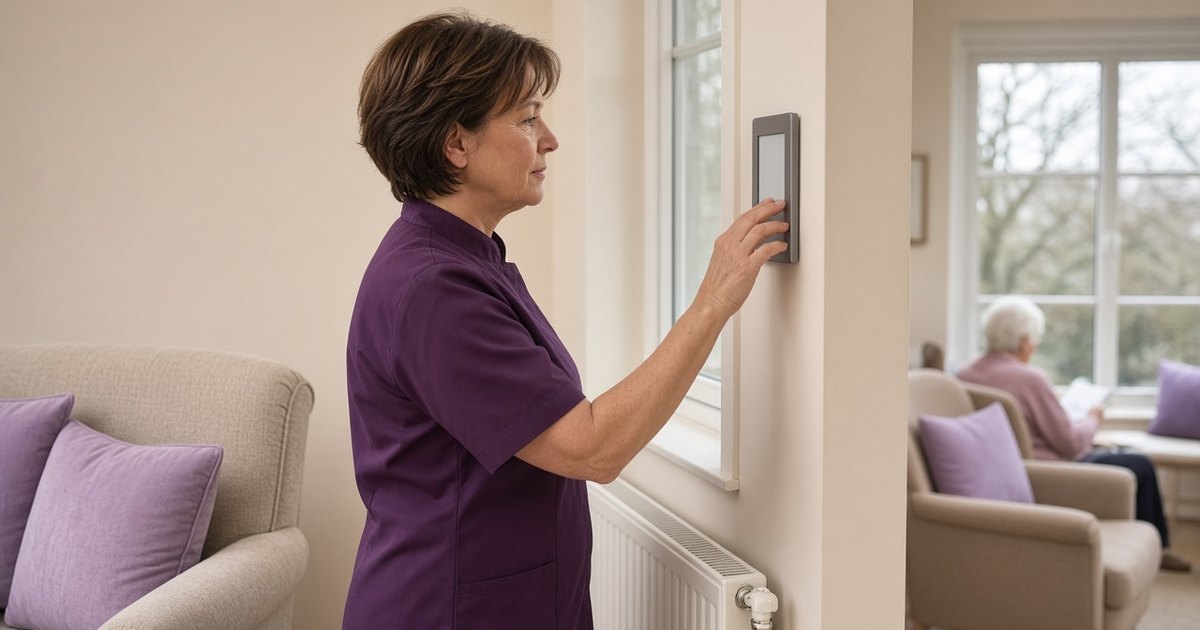
Set heating by zone and time. Keep residents’ rooms and lounges comfortable, but lower heat in offices, stores and unused rooms, and match staff-area heating to shift times.
Fit or check thermostatic radiator valves. Make sure each valve works and is set for the room’s use, and bleed radiators before winter.
Service boilers and check controls. A yearly service and correctly set time clocks stop boilers firing when they aren’t needed.
Insulate hot water pipes and cylinders. Never lower stored hot water below the temperature your Legionella risk assessment sets.
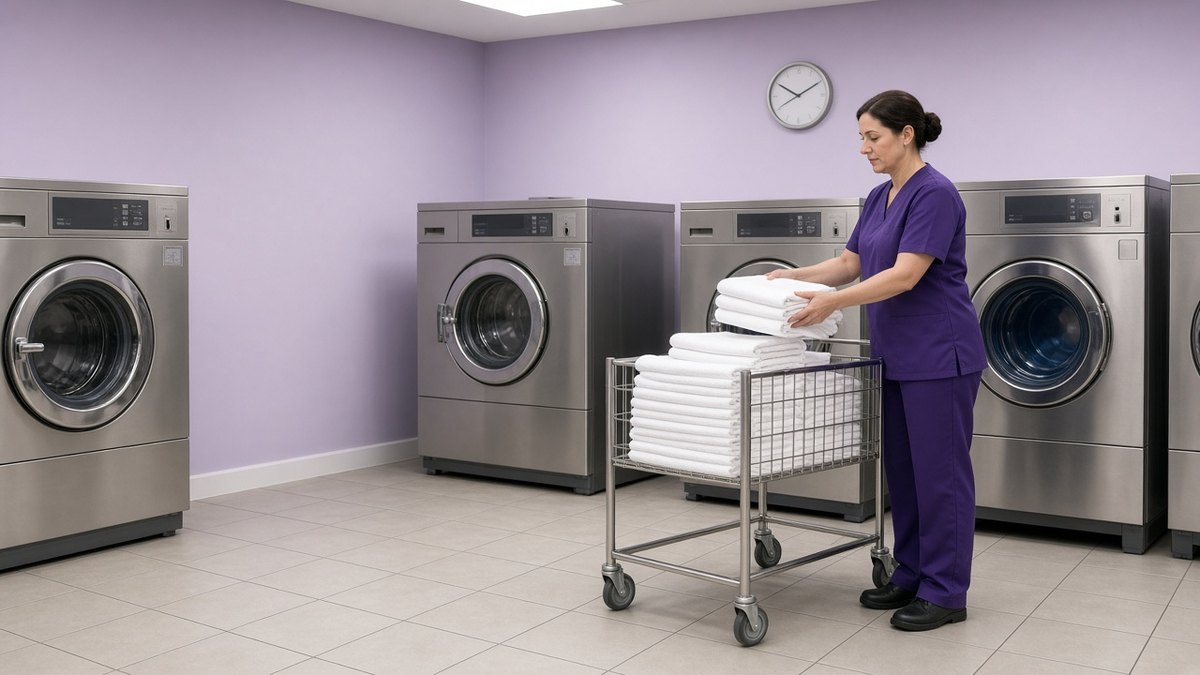
Run full laundry loads. Use lower-temperature washes where your infection control policy allows, and clean dryer filters every day.
Switch off kitchen kit between services. Ovens, hot cupboards and extractor fans left running between meals add up.
Swap to LED lighting. Add sensors in stores, staff toilets and plant rooms, and keep resident and escape routes lit as your fire plan requires.
Stop draughts. Fit door closers and draught strips on outside doors and check windows in lounges and bedrooms.
Name an energy champion. One person per shift who checks doors, lights and settings makes the other steps stick.
VAT on care home electricity and gas
HMRC’s VAT Notice 701/19 treats fuel and power for homes providing care for the elderly or disabled, children’s homes and hospices as qualifying use. Hospitals and hotels are not included. For qualifying electricity in Great Britain, a temporary 0% VAT rate applies from 1 October 2026 to 31 March 2027. In Northern Ireland, the rate stays at 5%. Gas for qualifying use stays at the reduced 5% rate.
Where a building has both qualifying and non-qualifying use, such as a care home with a large day centre or a staff training suite, the 60% rule applies. If at least 60% of the supply is for qualifying use, the whole supply can be treated as qualifying. If it is less, only the qualifying share gets the lower rate. Your supplier needs a certificate for each premises, with the exact percentage and a signed declaration. Standing charges follow the same VAT rate as the energy they relate to.
Very small supplies are treated as domestic automatically. HMRC’s limits are 33kWh a day or 1,000kWh a month for electricity, and 145kWh a day or 4,397kWh a month for gas. Our care home 0% VAT on electricity guide walks through the certificate step by step.
Climate Change Levy: when care homes pay it
The Climate Change Levy is a tax on business energy. From 1 April 2026, the main rate is £0.00801 per kWh for both electricity and gas, rising to £0.00827 per kWh from 1 April 2027, according to GOV.UK. But a supply is excluded from the levy if it is for domestic use, and GOV.UK’s list of domestic use includes homes for the elderly and disabled, children’s homes and hospices.
The same 60% rule applies. If domestic use is at least 60% of the total, the whole supply is excluded; if it is less, the levy is charged on the part that doesn’t qualify. Your supplier should ask for a certificate showing the percentage before it removes the levy.
VAT, levy and certificate rules at a glance
Item | Rule for qualifying care home use | Dates and figures | Source |
|---|---|---|---|
VAT on electricity (Great Britain) | Temporary 0% on qualifying use | 1 October 2026 to 31 March 2027 | HMRC VAT Notice 701/19 |
VAT on electricity (Northern Ireland) | Reduced rate on qualifying use | 5% | HMRC VAT Notice 701/19 |
VAT on gas | Reduced rate on qualifying use | 5% | HMRC VAT Notice 701/19 |
Mixed use | Whole supply qualifies if qualifying use is at least 60% | Certificate per premises with exact percentage | HMRC and GOV.UK |
Climate Change Levy | Excluded for homes for the elderly and disabled | Main rate £0.00801 per kWh; £0.00827 from 1 April 2027 | GOV.UK |
De minimis supplies | Treated as domestic automatically | Electricity 33kWh a day or 1,000kWh a month; gas 145kWh a day or 4,397kWh a month | HMRC VAT Notice 701/19 |
What the numbers say: for a home using 100,000kWh of electricity a year, a wrongly applied levy would add about £801 a year at the current rate, before VAT. That is why checking the certificate is the first item on the checklist.
Switching or renewing? Send your certificate again
HMRC’s guidance says suppliers must check certificates, including when a new supplier takes over a customer. In practice, this means your certificate doesn’t follow you automatically when you switch. Send a fresh certificate to the new supplier before the start date, and check the first bill for the right VAT rate and no levy on qualifying use.
Timing matters too. If a fixed contract ends without a new one in place, many suppliers move you onto out-of-contract or deemed rates, which are usually much higher. Our care home contract renewal checklist covers what to do and when, and the contract end checker helps you find your end date. For gas, read our care home gas contract guide.

Larger care groups: ESOS deadlines
If your care group is large, you may need to take part in the Energy Savings Opportunity Scheme. GOV.UK says a large undertaking is one with 250 or more employees, or turnover over £44 million and a balance sheet over £38 million. The qualification date for phase 4 is 31 December 2026, and notification is due by 5 December 2027. Organisations in phase 3 have a progress update due by 5 December 2026. The ESOS audit can give you a ranked list of energy saving measures across your homes.
Compare quotes on total yearly cost, not just the unit rate
- See unit rates and standing charges side by side for each home
- Send your VAT and levy certificate to the supplier you choose before the start date
- Useful for groups with several homes on different end dates
Fit summary
Check tax first: your bills show 20% VAT or a levy line on electricity used mainly for residents.
Get quotes now: your contract ends in the next six months, or you are already on out-of-contract or deemed rates.
Work the checklist: your contract is fine, but your kWh has crept up year on year.
Plan for ESOS: you are part of a group with 250 or more staff or large turnover and balance sheet.
Want a second opinion? Squid AI, SwitchSquid’s AI assistant, can help you turn your yearly kWh and quoted rates into a yearly cost for each home.
Important conditions
VAT and Climate Change Levy treatment depends on how each supply is used. Confirm your percentage and certificate with your accountant.
The 0% VAT rate on qualifying electricity applies in Great Britain from 1 October 2026 to 31 March 2027. Northern Ireland stays at 5%.
Business energy contracts are agreed contract by contract. Final prices depend on your meter data, usage and a credit check.
Never reduce hot water temperatures, lighting on escape routes or resident room heating below your care, fire and Legionella policies.
Our form is for business premises and non-domestic meters only, and we can’t advise on your tax position.
FAQ
Do care homes pay VAT on electricity?
For qualifying use in Great Britain, the VAT rate on electricity is 0% from 1 October 2026 to 31 March 2027, according to HMRC. In Northern Ireland, qualifying use stays at 5%.
Do care homes pay the Climate Change Levy?
Not on qualifying supplies. GOV.UK lists homes for the elderly and disabled, children’s homes and hospices as domestic use, which is excluded from the levy. If at least 60% of a supply is for that use, the whole supply is excluded; below 60%, the levy applies only to the part that doesn’t qualify.
What is the 60% rule for care homes?
If at least 60% of a supply is for qualifying use, the whole supply can be treated as qualifying for VAT and the levy. Below 60%, only the qualifying share gets the relief, and you need a certificate showing the exact percentage.
Do I need a new certificate if I switch supplier?
Yes, send one. HMRC says suppliers must check certificates, including when a new supplier takes over a customer, so don’t assume the old one transfers.
What are the quickest ways for a care home to save energy?
Check VAT and levy lines, send monthly meter readings, set heating by zone and time, and run full laundry loads. None of these affect resident care, and the tax check needs no spending at all.
Does a care home need to comply with ESOS?
Only if it is part of a large undertaking, with 250 or more employees, or turnover over £44 million and a balance sheet over £38 million. The phase 4 qualification date is 31 December 2026.
Are standing charges zero-rated too?
Standing charges follow the same VAT rate as the energy supply they relate to. So on qualifying electricity in Great Britain, they are also zero-rated during the temporary period.
Final decision card
The fastest care home energy saving in October 2026 is paperwork: make sure qualifying electricity shows 0% VAT and no Climate Change Levy, which otherwise costs about £80 for every 10,000kWh. Then work through the quick-wins checklist, send a fresh certificate whenever you switch, and get quotes well before your contract ends so you don’t drift onto out-of-contract rates. For more on suppliers, see our nursing home energy suppliers guide or the care homes sector page.
Contract ending in the next six months? Get care home quotes now
- Avoid out-of-contract and deemed rates by agreeing a new contract before your end date
- Quotes for electricity and gas, for single homes or groups
- Have 12 months of bills and your meter numbers ready
Questions about business energy? Ask Squid AI
Squid AI explains business energy contracts, renewal dates and switching in plain English, then points you to our business energy quote form.
- Save energy and moneyLearn when a longer fixed business contract makes sense.
- Save timeAnswers in seconds, no forms or sign-up.
- Plain answersNo jargon, no sales calls, free to use.